
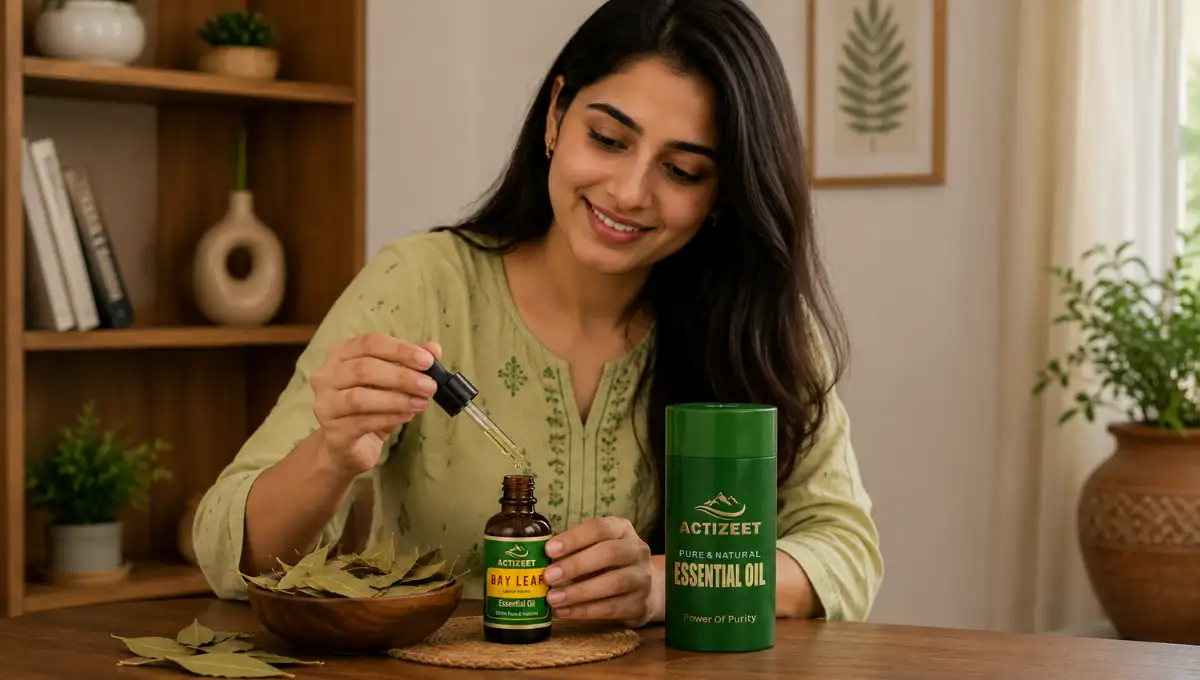
Best Bay Leaf Oil in India 2026: How to Find Genuine Laurus nobilis and Why ACTIZEET® Delivers the Real Tejpatta Botanical at Its Most Therapeutic
Bay leaf essential oil is one of India's most culturally resonant aromatics — the tejpatta that anchors every biryani, dal, and masala is also one of the most broadly documented therapeutic essential oils available. But India's 2026 market sells multiple different plants under the "bay leaf oil" label — Laurus nobilis, Pimenta racemosa, Umbellularia californica — with meaningfully different compound profiles and different therapeutic properties. Finding the genuinely best bay leaf oil in India requires knowing which botanical you need, how to verify it, and why ACTIZEET® is the most transparently quality-assured option available.
The tejpatta in your masala dabba is one of the most universally used spices in Indian cooking — it appears in biryanis and pulaos, in dal tadkas and masala preparations, in chutneys, in chai blends, and in the slow-cooked gravies that are the foundation of Indian regional cuisines from Kashmir to Kerala. It has simultaneously been documented as a medicinal herb in Charaka Samhita, Sushruta Samhita, and across both Ayurvedic and Unani medical traditions for its documented digestive, antimicrobial, anti-inflammatory, and respiratory therapeutic properties. This cultural familiarity makes bay leaf essential oil one of the most intuitively appealing aromatics for Indian wellness buyers — it is both therapeutically verified and deeply personally familiar.
The quality challenge for Indian buyers in 2026 is that this intuitive familiarity with the culinary tejpatta aroma does not necessarily translate to recognizing whether the "bay leaf essential oil" they are purchasing is genuine Laurus nobilis (the classical tejpatta of Indian cooking and Mediterranean-origin medicine), a different "bay" species with a different compound profile, or simply a fragrance preparation that smells bay-like without any genuine botanical therapeutic content. This guide resolves that quality challenge — explaining the specific species and compound verification that the best bay leaf oil in India must demonstrate, and establishing why ACTIZEET® Bay Leaf Essential Oil is the most reliably quality-verified option available to Indian buyers.
Laurus nobilis (True Bay Laurel — the correct botanical): The Mediterranean bay laurel whose leaves are the tejpatta of Indian cooking. Primary compounds: 1,8-cineole 30 to 55%, eugenol 5 to 15%, linalool 3 to 12%. The species whose therapeutic properties are documented in research and whose culinary use in Indian cooking you are familiar with. This is what you want when buying bay leaf oil for the research-documented therapeutic benefits. Pimenta racemosa (West Indian Bay — most common mislabeling in India): A Caribbean/West Indian tree primarily used for Bay Rum (the hair and skin tonic). Primary compounds: eugenol-dominant at 50 to 75%, chavicol, methyl eugenol — fundamentally different compound profile from L. nobilis. Much less 1,8-cineole. Legitimate in its own applications but not the therapeutic tejpatta of Indian medicine or cuisine. Often sold as "bay leaf oil" in India without species disclosure. Umbellularia californica (California Bay — rarer but sometimes imported): Contains umbellulone at significant concentrations — a compound that can cause headaches and irritation at high aromatic concentrations. Not appropriate for the same therapeutic applications as Laurus nobilis. The essential rule: Always verify Laurus nobilis as the species name on your bay leaf oil label. No Latin name on the label means no botanical identity confirmation.
Why Species Identity Is the #1 Quality Factor for Bay Leaf Oil in India
In most essential oil categories, the primary quality variable is compound purity and concentration within a single well-defined botanical source. Bay leaf oil is different — the primary quality variable is species identity, because multiple plants sold under the "bay leaf oil" name in India have genuinely different compound profiles and genuinely different therapeutic applications. Getting the species right is a prerequisite for all other quality considerations.
The practical reason Pimenta racemosa (West Indian Bay) is the most common mislabeling problem for bay leaf oil in India is straightforward: West Indian bay is a legitimate, commercially important aromatic plant that is more widely and more cheaply produced than Laurus nobilis. Its primary application in Bay Rum preparations means it has high commercial demand. And its aroma — warm, spicy, with some aromatic similarity to the bay laurel aromatic profile that Indian buyers expect — makes the mislabeling easy to overlook without analytical verification. West Indian bay oil (P. racemosa) is not a fraudulent or inferior product in its appropriate context — it is a genuinely valuable aromatic with its own legitimate applications. But when it is sold as "bay leaf essential oil" without species disclosure, it delivers an eugenol-dominant compound profile (50 to 75% eugenol) rather than the 1,8-cineole-dominant profile (30 to 55% 1,8-cineole) of genuine L. nobilis — which means buyers seeking the mucolytic respiratory, cognitive acetylcholinesterase, and 1,8-cineole-driven hair growth benefits of genuine bay laurel are not receiving the oil whose therapeutic mechanisms they researched.
Laurus nobilis vs Pimenta racemosa — The Side-by-Side That Every Indian Buyer Needs
| Feature | Laurus nobilis (True Bay Laurel) | Pimenta racemosa (West Indian Bay) |
|---|---|---|
| Primary compound | 1,8-Cineole: 30–55% — mucolytic, cognitive, antimicrobial, DHT-inhibiting for hair | Eugenol: 50–75% — clove-like dental antiseptic, antimicrobial, but different therapeutic emphasis |
| Eugenol content | 5–15% — supporting analgesic and antiseptic role | 50–75% — dominant compound, creates higher skin sensitization risk than L. nobilis |
| Respiratory benefit | Strong — 1,8-cineole mucolytic, expectorant, bronchodilatory | Weak — low 1,8-cineole means minimal mucolytic activity |
| Cognitive clarity | Documented — 1,8-cineole acetylcholinesterase inhibition | Minimal — eugenol does not share this mechanism |
| Hair growth (DHT) | Documented — 1,8-cineole 5-alpha reductase inhibition | Less relevant — the DHT inhibition mechanism is 1,8-cineole-specific |
| Skin sensitization risk | Moderate — 2% topical dilution limit | Higher — high eugenol content requires stricter dilution guidance |
| Traditional Indian use | This is the tejpatta — culinary and medicinal use in Indian tradition | Not traditionally used in Indian cooking or Ayurvedic medicine |
| Primary traditional use | Indian and Mediterranean culinary; Ayurvedic and Unani medicine | Bay Rum hair tonic — Caribbean tradition, not Indian |
| GC-MS distinction | High 1,8-cineole (30–55%) with linalool, alpha-terpinyl acetate, methyl chavicol, moderate eugenol | High eugenol (50–75%), myrcene, chavicol, methyl eugenol — completely different chromatographic fingerprint |
Why 1,8-Cineole Content Determines Therapeutic Value for Most Bay Leaf Applications
Once species identity is confirmed (Laurus nobilis), the primary quality variable becomes 1,8-cineole content — the compound that drives bay leaf oil's most researched and most valued therapeutic benefits and that should be present at 30 to 55% of total composition in high-quality genuine bay laurel essential oil.
The 1,8-cineole range in bay leaf oil varies by distillation origin, leaf harvest timing, and cultivation region. Mediterranean production from Spain, Greece, and Turkey produces oils consistently in the 35 to 55% cineole range. Turkish bay laurel oil is particularly noted for high cineole content and is often the reference standard for pharmaceutical-grade Laurus nobilis oil. Indian-cultivated bay laurel, where it exists, may have somewhat lower cineole content (30 to 45%) depending on growing conditions. Below 30% cineole in a claimed L. nobilis oil suggests either poor-quality starting material, incorrect harvest timing (immature leaves have lower cineole), or species adulteration.
GC-MS confirming 1,8-cineole at 30 to 55% serves as both a species verification and a therapeutic quality confirmation simultaneously — if a product genuinely contains Laurus nobilis leaf oil from appropriate harvest and distillation, the cineole content will fall in this range as a natural consequence of authentic botanical production. Cineole below this range or cineole without the characteristic supporting compounds (linalool, alpha-terpinyl acetate, methyl chavicol, moderate eugenol) indicates either poor quality or species substitution.
🌿 ACTIZEET® Bay Leaf Essential Oil: genuine Laurus nobilis with 1,8-cineole at 30 to 55% confirmed, eugenol at 5 to 15%, linalool and complete botanical compound matrix — the authentic tejpatta essential oil that India's wellness community deserves in 2026.
Shop ACTIZEET® →6 Quality Criteria for the Best Bay Leaf Oil in India
The label must clearly state Laurus nobilis L. as the botanical source. Any product labeled "bay leaf oil," "bay oil," or "tejpatta oil" without specifying the Latin species name provides no confirmation of botanical identity and could be Pimenta racemosa, Umbellularia californica, or a generic fragrance preparation with bay-like aromatic character but none of the L. nobilis therapeutic compound profile. This is not a minor pedantry — the species name is the single most important information on any bay leaf oil label because it is the only way to verify that the therapeutic applications you researched (1,8-cineole mucolytic, cognitive, hair growth) correspond to the product you are purchasing.
GC-MS analysis should confirm 1,8-cineole (eucalyptol) as the dominant compound at 30 to 55% of total composition, alongside the characteristic L. nobilis supporting compounds: eugenol at 5 to 15% (not eugenol-dominant which would indicate P. racemosa), linalool at 3 to 12%, alpha-terpinyl acetate at 3 to 10%, methyl chavicol at 3 to 8%, and the terpene fraction including alpha-pinene, sabinene, and beta-pinene. This compound fingerprint collectively confirms both species identity and appropriate harvest-distillation quality.
The eugenol content is particularly important as a species authentication marker: 1,8-cineole dominant with moderate eugenol (5 to 15%) is L. nobilis; eugenol dominant with low cineole is P. racemosa. A supplier providing GC-MS documentation should confirm both the dominant cineole and the moderate supporting eugenol — together these two data points distinguish genuine bay laurel from the most common substitute more reliably than any single compound alone.
The highest-quality Laurus nobilis essential oil, by GC-MS-verified cineole content and aromatic quality, is consistently produced from Mediterranean cultivation — particularly Turkish bay laurel from the Aegean coast and Southwestern Turkey, which produces oil with among the highest verified cineole content in the global supply. Spanish and Greek bay laurel also produce high-quality oil. The geographic origin of the bay laurel cultivation influences the cineole content through soil, climate, altitude, and cultivar differences that research has confirmed produce meaningful differences in therapeutic compound profiles.
Suppliers who specify their bay leaf oil's country of origin demonstrate supply chain accountability and botanical knowledge that correlates with genuine product quality control. ACTIZEET® knows their bay leaf source origin because they maintain direct relationships with verified L. nobilis distillers rather than purchasing through commodity aromatic markets where species accuracy and origin accountability are difficult to maintain.
Genuine bay leaf essential oil is produced by steam distillation from the leaves (and sometimes small branches) of Laurus nobilis — the plant part with the highest concentration of the volatile aromatic therapeutic compounds. Bay laurel produces different compound profiles from different plant parts — the fruit/berry of L. nobilis contains a high-fixed-oil fraction (laurel berry oil, used in cooking) that is not the same product as the steam-distilled leaf essential oil. The extraction method (steam distillation) and plant part (leaves) should both be specified in the product documentation to confirm the correct source for the 1,8-cineole-dominant therapeutic profile.
The best bay leaf oil in India is undiluted — pure steam-distilled L. nobilis leaf essential oil without carrier oil dilution or the addition of synthetic 1,8-cineole (eucalyptol) to artificially boost the apparent cineole content of a low-quality or adulterated starting material. The purity test for bay leaf oil: drop a small amount on white paper and allow to evaporate at room temperature. Genuine undiluted bay leaf essential oil evaporates completely within 20 to 30 minutes without leaving a permanent oily stain. If a visible oily ring remains after complete evaporation time, carrier oil dilution is present. Synthetic eucalyptol addition is more difficult to detect without GC-MS but creates an abnormally clean cineole peak without the supporting botanical minor compound matrix.
Genuine bay leaf essential oil's 1,8-cineole and monoterpene compounds oxidize with UV light exposure, reducing cineole content over time and increasing the concentration of oxidized terpene derivatives that can cause skin sensitization at lower concentrations than the fresh oil. Dark amber glass with an airtight seal is the appropriate preservation packaging. Additionally, the best bay leaf oil supplier provides clear dilution guidance specific to bay leaf's 2% maximum topical concentration — acknowledging the eugenol content that, while lower than in clove or P. racemosa oils, still requires appropriate dilution respect. Suppliers providing complete safety information demonstrate product knowledge that correlates with quality accountability across all aspects of their operation.
Red Flags: What to Avoid When Buying Bay Leaf Oil in India
- No Latin species name on the label. The single most critical red flag for bay leaf oil specifically — because the "bay" naming confusion between L. nobilis, P. racemosa, and U. californica means that without a confirmed species name you have no botanical identity verification. Never purchase bay leaf essential oil without Laurus nobilis clearly stated.
- Strongly clove-like aroma rather than camphoraceous-herbal. Genuine Laurus nobilis has a distinctive camphoraceous-herbal aromatic character from its 1,8-cineole dominance — recognizable as "bay leaf" from the tejpatta in your kitchen, with some warmth from eugenol but primarily herbaceous-camphoraceous. An oil that smells predominantly like cloves is eugenol-dominant — almost certainly Pimenta racemosa rather than Laurus nobilis.
- GC-MS showing eugenol as the dominant compound above 30%. In genuine Laurus nobilis, eugenol is a supporting compound at 5 to 15%. Eugenol above 30% as the dominant or co-dominant compound indicates Pimenta racemosa or another eugenol-dominant species rather than true bay laurel.
- Very low price for claimed Mediterranean-origin Laurus nobilis oil. Genuine L. nobilis steam-distilled leaf oil from Mediterranean sources has production economics that establish a price floor. Products claiming pure Turkish or Spanish bay laurel at prices below what Mediterranean agricultural and distillation production costs allow are likely either Indian-grown low-quality material, P. racemosa substitution, or heavily diluted genuine oil.
- Labeled "Bay Rum oil" or with Bay Rum applications mentioned. Bay Rum is traditionally made with Pimenta racemosa — if a product's label or product description mentions Bay Rum applications or comparisons, the botanical source is almost certainly P. racemosa rather than L. nobilis regardless of how the product itself is labeled.
- No dilution guidance or inappropriate dilution guidance. Bay leaf oil at 2% maximum topical is an important safety specification that knowledgeable suppliers provide. Suppliers claiming bay leaf oil is safe for undiluted application or providing no dilution guidance are either uninformed about their product's eugenol content sensitization risk or prioritizing sales over buyer safety.
India Bay Leaf Oil Market 2026: What You Are Choosing Between
| Market Category | L. nobilis Named | 1,8-Cineole 30–55% | Eugenol Moderate (5–15%) | Origin Disclosed | Therapeutic Value |
|---|---|---|---|---|---|
| Pimenta racemosa Mislabeled West Indian Bay sold as Bay Leaf |
No — P. racemosa | Low — 5–15% only | No — eugenol dominant 50–75% | Absent | Wrong profile for L. nobilis uses |
| Generic "Bay Oil" No Species Unknown botanical identity |
Unconfirmed | Unknown | Unknown | Absent | Unpredictable |
| Mid-Tier L. nobilis Genuine species, limited verification |
Often | Likely — unconfirmed range | Probably | Sometimes | Good — unverified |
| ACTIZEET® Bay Leaf Oil GC-MS verified L. nobilis — complete |
Yes — L. nobilis | Yes — 30–55% confirmed | Yes — 5–15% supporting eugenol | Yes — Mediterranean origin | Full — verified therapeutic grade |
Why ACTIZEET® Is the Best Bay Leaf Oil in India in 2026
ACTIZEET® Bay Leaf Essential Oil — Laurus nobilis Confirmed, 1,8-Cineole at 30–55%, Authentic Mediterranean Origin, India's Most Verified Tejpatta Botanical
ACTIZEET® Bay Leaf Essential Oil addresses every quality challenge in India's 2026 bay leaf oil market. Laurus nobilis botanical species clearly specified — eliminating the P. racemosa and generic "bay oil" confusion that affects the majority of India's bay leaf oil offerings. GC-MS confirming 1,8-cineole at 30 to 55% with the supporting linalool, alpha-terpinyl acetate, and moderate eugenol compound matrix that confirms authentic botanical identity and therapeutic quality simultaneously. Mediterranean origin providing the high-cineole-yield cultivation environment that produces the most therapeutically potent L. nobilis leaf oil. Steam distillation from leaves — the plant part with the highest therapeutic compound concentration. 100% pure without carrier dilution or synthetic eucalyptol addition. Complete dilution safety guidance. Dark glass UV protection. The tejpatta botanical that India has cooked with and healed with for centuries — in its most quality-verified essential oil form available in 2026.
- Laurus nobilis species confirmed — the botanical identity verification that eliminates the most common India market substitution problem.
- 1,8-Cineole at 30 to 55% GC-MS verified — the therapeutic compound concentration that delivers mucolytic respiratory, cognitive acetylcholinesterase, DHT-inhibiting hair growth, and antimicrobial NF-kB benefits.
- Moderate eugenol at 5 to 15% — the supporting analgesic and antiseptic fraction at the correct range for L. nobilis rather than the eugenol-dominant profile of P. racemosa substitutes.
- Mediterranean origin — the geographic source accountability that connects ACTIZEET®'s oil to the highest-cineole L. nobilis production regions globally.
- Complete dilution guidance and safety transparency — the product knowledge communication that serious buyers deserve and that separates genuinely quality-accountable suppliers from those prioritizing sales over buyer safety.
Getting the Most from ACTIZEET® Bay Leaf Oil
Cognitive Clarity Diffusion
3 to 4 drops in a 100 ml diffuser during study, work, or any demanding cognitive activity. The 1,8-cineole acetylcholinesterase inhibition provides measurable working memory and focus improvements confirmed in human research — the most unique cognitive benefit among common essential oils and ACTIZEET® bay leaf's most distinctive aromatherapy application.
Respiratory Steam Inhalation
2 drops in hot water with towel tent. 5 to 8 minutes maximum. The 1,8-cineole mucolytic, expectorant, and bronchodilatory triple-action respiratory mechanism — identical to eucalyptol's pharmaceutical respiratory activity — in the warming, slightly herbal tejpatta aromatic that most Indian users find significantly more culturally familiar and emotionally comforting than pure eucalyptus.
Hair Growth Scalp Treatment
5 to 6 drops in 2 tablespoons of castor oil. Massage into scalp, leave 30 to 45 minutes, then shampoo. The 1,8-cineole 5-alpha reductase DHT inhibition plus scalp circulation stimulation — weekly for 8 to 12 weeks for visible hair density and scalp health improvement. Combine with rosemary oil for the most evidence-backed two-oil hair growth stack.
Joint Pain Massage (Max 2%)
4 to 5 drops in 2 tablespoons of warm sesame oil. Massage into arthritic joints, sore muscles. NF-kB anti-inflammatory combined with eugenol COX-2 analgesic delivers multi-mechanism pain relief at the joint site without the GI side effect burden of oral NSAIDs. Do not exceed 2% concentration. Patch test essential.
Household Antimicrobial Spray
15 drops in 500 ml water with dish soap. Use on kitchen surfaces, bathroom areas. The 1,8-cineole and eugenol broad-spectrum antimicrobial coverage against Salmonella, E. coli, and Staphylococcus in the tejpatta aromatic that turns household disinfection into a culturally familiar kitchen-spice sensory experience.
Sleep and Stress Relief
2 to 3 drops in diffuser 30 minutes before sleep, or add 1 drop to a tissue near the pillow. Linalool's GABA-A anxiolytic and alpha-terpinyl acetate's mild sedative combine with 1,8-cineole's respiratory opening for the most complete pre-sleep aromatic preparation — simultaneously calming, anxiety-reducing, and respiratory-clearing for the most comfortable sleep onset.
Pure Laurus nobilis leaf essential oil. 1,8-Cineole at 30 to 55% confirmed. Eugenol at 5 to 15% supporting — not dominant. Mediterranean origin. GC-MS verified botanical fingerprint confirming the species identity and compound profile that corresponds to the research-documented therapeutic applications. No synthetic eucalyptol addition. No Pimenta racemosa substitution. The tejpatta botanical that Indian cooking and Indian medicine have relied on for thousands of years — in the most honestly labeled, most quality-verified, and most therapeutically genuine essential oil form available to Indian buyers in 2026.
🌿 Order ACTIZEET® Bay Leaf Essential Oil →Frequently Asked Questions
The Best Bay Leaf Oil in India 2026: Verified Species, Confirmed Cineole, Authentic Tejpatta Botanical
The best bay leaf oil in India in 2026 answers two questions that most products in this category leave unanswered. Is it genuinely Laurus nobilis — the tejpatta of Indian culinary and medicinal tradition — and not the eugenol-dominant Pimenta racemosa that is frequently substituted under the same "bay leaf oil" label? And does GC-MS confirm 1,8-cineole at 30 to 55% with the botanical supporting compound fingerprint that distinguishes genuine L. nobilis leaf oil from eucalyptol-enhanced imitations?
ACTIZEET® Bay Leaf Essential Oil answers both questions with full documentation and transparency. Laurus nobilis species named. 1,8-Cineole at 30 to 55% with supporting linalool, alpha-terpinyl acetate, and moderate eugenol confirmed. Mediterranean origin documented. Complete safety guidance provided. The tejpatta that has been in Indian kitchens and Indian medicine since antiquity — now in its most quality-verified, most honestly labeled, and most therapeutically genuine essential oil form available to Indian buyers in 2026.
Latest From Our Blog

Best Ginger Oil in India 2026: A Complete Buyer’s Guide to Pure, Authentic Zingiber officinale Essential Oil
Looking for the best ginger oil in India in 2026?...

Best Aniseed Oil in India 2026: How to Find Genuine Pimpinella anisum and Why ACTIZEET® Delivers the Authentic Saunf Botanical at Its Most Therapeutic
Looking for the best aniseed oil in India? Learn how...

Best Mogra Oil in India 2026: A Complete Buyer’s Guide to Pure, Authentic Jasminum sambac Essential Oil
Looking for the best mogra oil in India in 2026?...

15 Bay Leaf Essential Oil Benefits: How Laurus nobilis 1,8-Cineole, Eugenol, and Linalool Deliver Antimicrobial Power, Pain Relief, Hair Growth, and Stress Relief
Discover 15 proven bay leaf essential oil benefits — from...