
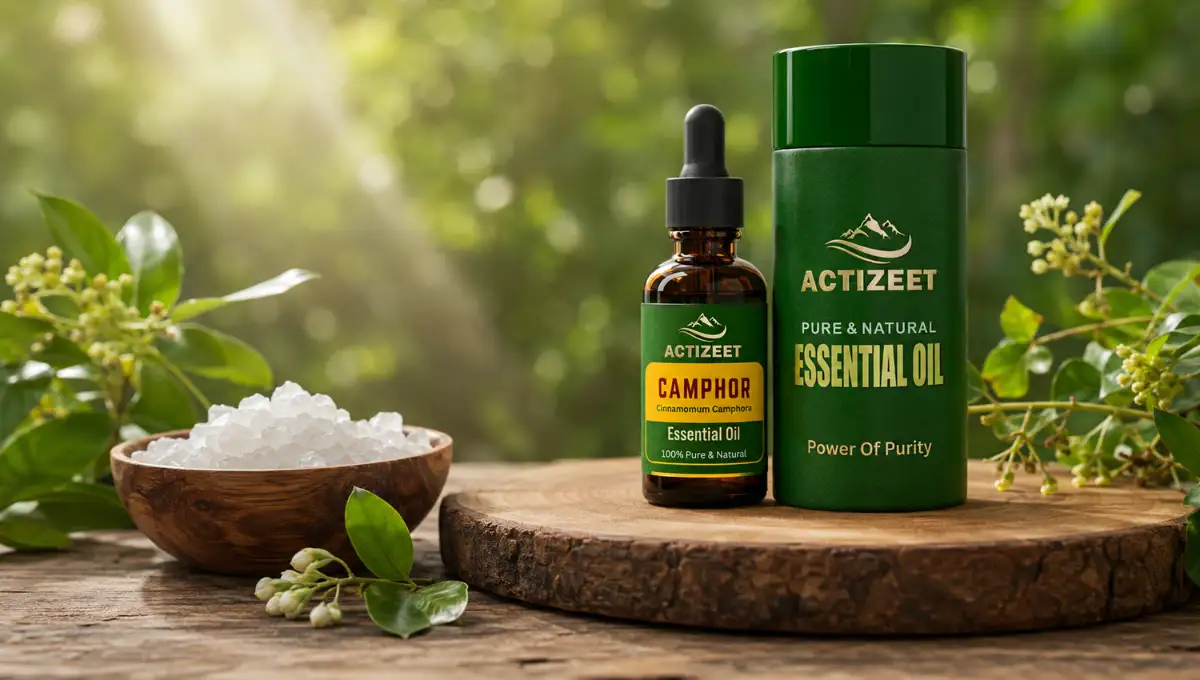
Best Camphor Oil in India 2026: Why Grade, Source, and Compound Transparency Make All the Difference — and Why ACTIZEET® Leads the Field
India's camphor oil market in 2026 is crowded with products that call themselves camphor essential oil but differ enormously in what is actually inside the bottle. Synthetic camphor fragrance, yellow camphor oil with harmful safrole, and genuine white camphor essential oil with therapeutic 1,8-cineole all circulate under the same "camphor oil" label. This guide explains what to look for, which red flags to avoid, and why ACTIZEET® is the most verified, most trusted camphor oil available to Indian buyers this year.
Camphor is one of those botanical products that every Indian household has used in one form or another for generations — the crystalline camphor tablets for puja, the Vicks on the chest in winter, the camphor-coconut oil hair preparation from grandmother's kitchen. This universal familiarity creates a specific market problem: most Indian buyers do not think to scrutinize "camphor oil" as carefully as they might scrutinize a less familiar essential oil, because the experience of camphor feels intimate and known. The aroma is immediately recognized. The purpose is understood.
But there are three genuinely different products circulating under the camphor oil name in India's 2026 wellness market, and the differences between them are not minor. They are differences in botanical authenticity, in therapeutic compound content, and in one critical case — camphor oil grade — in safety. Understanding these differences is the foundation of finding the best camphor oil in India for your specific needs.
The three products are: synthetic camphor fragrance oil (isolated synthetic bornan-2-one compound, often in a carrier, providing only the camphor analgesic mechanism without the 1,8-cineole respiratory support and linalool anxiolytic activity of genuine botanical oil), yellow camphor oil (a distillation fraction with elevated safrole content that requires caution and is not appropriate for regular therapeutic essential oil applications), and genuine white camphor essential oil from Cinnamomum camphora (the therapeutic-grade product with 1,8-cineole at 30 to 45%, camphor at 15 to 25%, and the complete botanical compound matrix that delivers the full therapeutic profile documented in pharmacological research).
This guide tells you how to identify each, what the quality criteria for genuine white camphor essential oil look like, and why ACTIZEET® Camphor Essential Oil is consistently the most reliably verified choice for Indian buyers who want the genuine article.
Product 1 — Synthetic Camphor Fragrance Oil: Isolated synthetic bornan-2-one (camphor compound) in a carrier. Smells like camphor. Provides TRPM8 analgesic activity from the camphor molecule. Contains zero 1,8-cineole, zero linalool, zero borneol — the compounds responsible for respiratory support, anxiolytic benefit, and broader therapeutic depth of genuine botanical oil. Appropriate for applications where isolated camphor analgesic activity is the only goal. Not genuine botanical essential oil. Product 2 — Yellow Camphor Oil: The middle distillation fraction of camphor tree steam distillation. Contains higher camphor content and elevated safrole — a hepatotoxic compound regulated or banned as a food additive in many countries. Not recommended for regular therapeutic essential oil use. Product 3 — White Camphor Essential Oil (what you want): The lightest distillation fraction of Cinnamomum camphora. 1,8-Cineole at 30 to 45%, camphor at 15 to 25%, linalool at 10 to 15%, borneol and alpha-terpineol. No harmful safrole content. The therapeutic-grade camphor oil appropriate for aromatherapy, topical pain relief, respiratory support, and all the documented applications covered in this guide.
The Three Camphor Oil Products in India's Market — A Clear Comparison
| Feature | Synthetic Camphor Fragrance | Yellow Camphor Oil | White Camphor EO (Correct) |
|---|---|---|---|
| Source | Synthetic camphor + carrier | C. camphora — middle distillation fraction | C. camphora — lightest distillation fraction |
| Camphor content | Variable — often very high as pure isolate | High (25–50%) | 15–25% — appropriate therapeutic ratio |
| 1,8-Cineole | Zero | Low | 30–45% — major respiratory benefit compound |
| Linalool | Zero | Trace | 10–15% — anxiolytic contribution |
| Safrole | Zero | Present — elevated, concerning | Absent or trace — safe for therapeutic use |
| Safety for regular use | Generally safe for topical camphor analgesic use; not botanical oil | Caution advised — safrole toxicity risk | Safe for therapeutic aromatherapy and topical use when properly diluted |
| Appropriate use | When isolated camphor analgesic activity only is needed | Not recommended for regular EO applications | All therapeutic aromatherapy and topical applications |
| Regulatory status | Camphor FDA-recognized OTC active at 3–11% | Safrole restricted/banned in food use internationally | Safe therapeutic essential oil for aromatherapy and topical use |
Why Camphor Oil Grade Is Both a Quality and a Safety Issue
The camphor oil grade distinction is unique in this guide series — it is the only essential oil category where the wrong product within the same botanical species represents not just reduced therapeutic quality but a genuine safety concern. The safrole content of yellow and brown camphor oil fractions is not a minor chemical difference to be noted and moved past. Safrole is classified as a potential carcinogen by the International Agency for Research on Cancer (IARC), is banned as a food additive in the United States and European Union, and is specifically controlled by law enforcement agencies globally because of its use as a MDMA precursor chemical. Products containing significant safrole are not appropriate for regular skin application or regular aromatic inhalation, regardless of how they are marketed.
The genuine white camphor essential oil that ACTIZEET® provides — the lightest distillation fraction with 1,8-cineole dominant at 30 to 45% and camphor at 15 to 25% — contains absent to trace safrole content that is not a toxicological concern at therapeutic essential oil use concentrations. This is the grade that Ayurvedic practitioners use, that aromatherapy research has validated, and that belongs in an Indian household wellness cabinet. The yellow and brown fractions do not.
The problem for Indian buyers in 2026 is that most products sold as "camphor oil" in the Indian market do not specify the distillation grade. A product that says only "camphor essential oil" without specifying "white camphor" cannot confirm that it is the safe therapeutic grade rather than a higher-safrole fraction. This labeling omission is the camphor-specific quality concern that makes supplier grade transparency the most critical purchasing criterion for this particular oil.
🪨 ACTIZEET® Camphor Essential Oil: verified white camphor from Cinnamomum camphora with 1,8-cineole at 30 to 45%, camphor at 15 to 25%, safrole absent — the safe, therapeutic-grade kapoor oil India's wellness needs deserve.
Shop ACTIZEET® →6 Quality Criteria for the Best Camphor Oil in India
The single most important quality criterion for camphor essential oil — more important than for any other oil in this guide series — is the explicit specification that the product is white camphor oil, not yellow or brown camphor. The label should state "white camphor essential oil" or "Cinnamomum camphora — white fraction" or equivalent language that unambiguously identifies the distillation grade.
A camphor oil label that says only "camphor essential oil" or "camphor oil" without grade specification cannot confirm that the safe, low-safrole white camphor fraction was used. Given the meaningful safety distinction between grades, this specification is not optional labeling detail — it is the fundamental safety transparency requirement for any camphor oil product sold in India. ACTIZEET® specifies white camphor grade because they understand that Indian buyers using camphor oil for regular therapeutic applications deserve to know that the product they are applying to their skin and inhaling regularly is the safe grade of this multi-fraction botanical oil.
The label should clearly state Cinnamomum camphora (L.) J.Presl as the botanical source, confirming genuine camphor tree origin rather than a synthetic camphor fragrance preparation. This matters because synthetic camphor — isolated bornan-2-one produced from turpentine without any Cinnamomum camphora involvement — is widely available and is often sold under the "camphor oil" name in the Indian market. Synthetic camphor provides only the TRPM8 analgesic mechanism of the camphor compound without the 1,8-cineole respiratory support, linalool anxiolytic activity, or borneol analgesic contributions of genuine botanical camphor tree distillation.
The extraction method specification — steam distillation — further confirms genuine botanical essential oil processing rather than chemical synthesis or solvent extraction of camphor compound. Any reputable camphor essential oil supplier will disclose both the botanical species and the extraction method as baseline product transparency.
GC-MS analysis for white camphor essential oil should confirm the compound profile expected of the light fraction: 1,8-cineole (eucalyptol) as the dominant compound at 30 to 45% of total composition, camphor at 15 to 25%, linalool at 10 to 15%, borneol at 3 to 7%, and alpha-terpineol at 3 to 6%. Critically, safrole should appear as absent or at trace levels well below toxicological concern thresholds — this is the analytical confirmation that white camphor grade was distilled rather than the higher-safrole yellow fraction.
The 1,8-cineole percentage is the most important compound marker for verifying white camphor grade — it is the compound that distinguishes the light fraction most clearly from the heavier fractions, and its presence at 30 to 45% confirms the distillation was cut appropriately to collect the therapeutically valuable, low-safrole fraction. GC-MS data confirming 1,8-cineole dominance and safrole absence simultaneously provides both the therapeutic quality verification and the safety verification that white camphor grade should deliver.
Genuine white camphor essential oil sold as a pure essential oil contains only the steam-distilled volatile compound fraction from Cinnamomum camphora light fraction distillation — no synthetic camphor compound added to boost the aromatic strength or analgesic concentration of a weaker botanical batch, and no carrier oil added for volume. Both adulterations are detectable through appropriate testing: synthetic camphor addition would show anomalously high camphor percentage without the supporting botanical minor compound matrix in GC-MS analysis, and carrier oil dilution is detectable through the paper evaporation test.
The purity requirement for camphor essential oil is particularly important for safety as well as quality: if synthetic camphor is added to the botanical oil to create a product with higher camphor concentration than the white fraction naturally produces, the resulting preparation may exceed the FDA's recognized safe OTC concentration range of 3 to 11% for topical camphor use when buyers apply it at what they believe are appropriately diluted concentrations. Knowing the exact camphor percentage through GC-MS-verified pure botanical oil allows buyers to calculate their dilution ratios accurately and stay within therapeutically effective and safety-validated concentration ranges.
White camphor essential oil's 1,8-cineole dominant compound profile — while more stable than the reactive aldehydes and esters of some other essential oils — undergoes gradual photo-oxidative changes under UV light exposure that can degrade both the aromatic quality and the compound profile over time. Amber glass packaging blocks the UV wavelengths responsible for this oxidation, ensuring the GC-MS-confirmed compound profile remains intact from production through the consumer's use of the bottle.
For an oil being purchased specifically for the 1,8-cineole respiratory mucolytic and expectorant activity (Benefit 2 in our benefits guide), the borneol analgesic contribution, and the linalool anxiolytic depth, preserving these minor compounds' integrity through appropriate packaging is the difference between an oil whose full therapeutic profile is available and one that has had its minor compound depth degraded by months of UV exposure in a clear glass bottle on a sunlit shelf.
This criterion is unique to camphor oil in this guide series — a supplier who provides no clear children's age restriction and pregnancy warning on their camphor essential oil product is demonstrating either insufficient product knowledge or insufficient concern for buyer safety. The risks of camphor near infants and young children under 2 years (documented seizure risk even from aromatic exposure) and during pregnancy are documented, specific, and serious enough that their absence from product documentation is a meaningful quality flag.
A camphor oil brand that takes quality seriously understands and communicates these specific safety parameters — because camphor is one of the few commonly sold essential oils where incorrect use in vulnerable populations represents a genuine medical emergency risk rather than merely sub-optimal therapeutic outcomes. ACTIZEET® documents these safety requirements because they have thought carefully about who uses their product and what those users need to know to use it safely. This care in safety communication reflects the same commitment to buyer wellbeing that drives their quality sourcing and testing standards.
Red Flags: What to Avoid When Buying Camphor Oil in India
- No grade specification (white, yellow, brown) on the label. This is the most critical red flag unique to camphor oil. Without knowing the distillation grade, you cannot confirm you have safe white camphor rather than higher-safrole yellow camphor. Any camphor oil supplier who understands their product will specify the grade. Absence of this information is a reason to seek a different supplier.
- No botanical name (Cinnamomum camphora) on the label. Without the Latin name, you cannot distinguish genuine botanical white camphor essential oil from synthetic camphor fragrance oil. Both may smell like camphor, but only the genuine botanical oil provides the 1,8-cineole respiratory support and full compound therapeutic profile that most buyers are specifically purchasing camphor oil to access.
- Unusually high camphor smell intensity with sharp, chemical-synthetic character. Genuine white camphor essential oil has a complex aromatic profile where the sharp camphor note is balanced by the fresh-medicinal 1,8-cineole character and the soft floral-calming linalool dimension. An extremely intense, one-dimensional camphor aroma without these supporting aromatic notes suggests either synthetic camphor isolate or the higher-camphor yellow fraction rather than the balanced compound profile of genuine white camphor.
- No children's safety warning or age restriction on the label. Camphor oil without a warning against use near infants and children under 2 years is a product that either does not know about this documented safety risk or has decided not to communicate it. Either conclusion is a reason to choose a different supplier.
- Clear glass or plastic packaging. UV-protective amber glass is the appropriate standard for camphor essential oil. Clear packaging does not protect the 1,8-cineole compound fraction or the minor compound depth from photo-oxidative degradation during storage.
- Price that seems inconsistent with genuine steam-distilled botanical camphor essential oil. While camphor is not among the most expensive essential oils — the camphor tree is widely cultivated and the distillation yield is reasonable — products priced significantly below market rate for genuine steam-distilled white camphor essential oil are more likely to be synthetic camphor preparations or adulterated products.
- Claims of suitability for infants or very young children. Any camphor oil product claiming to be safe for use on or near children under 2 years is making a claim that directly contradicts documented medical evidence on camphor seizure risk in infants and toddlers. This specific unsupported claim is a strong signal that the supplier does not have the safety knowledge that responsible camphor oil marketing requires.
India Camphor Oil Market 2026: What You Are Choosing Between
| Market Category | Typical Price | Grade Stated | Species Named | GC-MS Backed | Safe for Therapeutic EO Use |
|---|---|---|---|---|---|
| Synthetic Camphor Fragrance Oil Isolated bornan-2-one in carrier |
₹80 – ₹200 | No grade | Not botanical | No | Analgesic only |
| Ungraded / Unlabeled EO Camphor EO, grade unknown |
₹150 – ₹350 | Absent | Sometimes | No | Unknown — safety risk |
| Mid-Tier Wellness Brands Probably white camphor, unconfirmed |
₹250 – ₹550 | Occasionally | Often | Rarely | Likely — unconfirmed |
| ACTIZEET® — Verified White Camphor White grade stated, GC-MS, safrole absent |
Premium tier | Yes — White camphor | Yes — C. camphora | Yes — 1,8-cineole confirmed | Yes — safrole absent confirmed |
The Safe for Therapeutic EO Use column is the most consequential in the camphor comparison specifically. The ungraded / unlabeled category represents a genuine safety unknown — not just a quality concern — that buyers should not accept for an oil with camphor's documented grade-dependent safety profile. The "probably white camphor, unconfirmed" description for mid-tier brands is accurate for many honest Indian wellness companies that do source appropriate camphor oil but have not implemented the labeling transparency that would allow buyers to verify it independently. ACTIZEET® closes this gap with explicit grade declaration and accessible GC-MS compound data.
Why ACTIZEET® Is the Best Camphor Oil in India in 2026
ACTIZEET® has built its position in India's essential oil market on verifiable quality — not just on claims that their products are good, but on the label information and analytical data that allows buyers to verify independently that the claims are true. For camphor specifically, where grade declaration and safrole absence are both quality and safety requirements, this verifiable transparency matters more than for most other essential oils in their range.
ACTIZEET® Camphor Essential Oil — Verified White Camphor, Cinnamomum camphora, 1,8-Cineole Confirmed, Safrole Absent
ACTIZEET® Camphor Essential Oil addresses every quality and safety criterion that separates genuinely trustworthy camphor oil from the unverified products that dominate India's 2026 camphor oil market. White camphor grade explicitly stated. Cinnamomum camphora botanical species confirmed. GC-MS analysis confirming 1,8-cineole at 30 to 45% and safrole absent. 100% pure and undiluted botanical steam distillate. UV-protective amber glass packaging. Clear safety documentation including children's age restrictions and pregnancy contraindication. For Indian buyers who want the best camphor oil in India in 2026 — genuinely safe, genuinely botanical, genuinely verified — ACTIZEET® is the answer.
Six Reasons ACTIZEET® Leads India's Camphor Oil Market in 2026
- White camphor grade declared — the most important safety transparency in the camphor category. You know you are purchasing the safe, low-safrole, therapeutically appropriate white fraction rather than the higher-safrole yellow fraction that requires caution. This single declaration eliminates the most consequential safety ambiguity in the entire camphor oil market.
- 1,8-Cineole at 30 to 45% confirmed by GC-MS — the respiratory compound that distinguishes genuine white camphor from synthetic isolate. The 1,8-cineole that makes white camphor essential oil comprehensively therapeutic for respiratory conditions is present at its characteristic white-fraction concentration. Synthetic camphor has none. Yellow camphor has far less. White camphor from ACTIZEET® has it at verified therapeutic levels.
- Safrole confirmed absent — the analytical safety verification that no label claim can substitute for. GC-MS analysis showing safrole absent in the compound chromatogram is the only genuine verification that white camphor grade was correctly distilled and that the product does not contain the hepatotoxic compound that makes yellow and brown camphor fractions inappropriate for regular therapeutic use.
- Cinnamomum camphora species and steam distillation confirmed. You know you have genuine botanical camphor tree oil, not synthetic camphor fragrance, not a different Lauraceae species, and not a chemically modified preparation.
- Amber glass UV protection preserving compound integrity. The 1,8-cineole, linalool, and borneol compounds that contribute the respiratory and anxiolytic therapeutic dimensions beyond basic camphor analgesic activity arrive at their GC-MS-confirmed concentrations rather than degraded by UV photo-oxidation during storage.
- Comprehensive safety documentation reflecting genuine understanding of camphor's specific risk profile. ACTIZEET® provides the children's age restriction, pregnancy contraindication, dilution requirements, and never-ingest guidance that camphor oil specifically requires. This depth of safety communication reflects the same commitment to buyer wellbeing that drives their sourcing and testing standards.
Getting the Most from ACTIZEET® White Camphor Essential Oil
Joint and Muscle Pain
Dilute 3 to 5 drops in 1 tablespoon of coconut oil (3 to 5% maximum for body use). Massage firmly into painful joints, sore muscles, and aching lower back. TRPM8-mediated analgesic relief begins within minutes. The FDA recognizes camphor at 3 to 11% as a safe and effective OTC pain relief agent — this is the basis for Vicks, Tiger Balm, and similar preparations.
Steam Inhalation for Congestion
Add 2 to 3 drops to a bowl of very hot water. Lean over with a towel tent and inhale for 5 to 10 minutes. The 1,8-cineole mucolytic and camphor TRPM8 nasal-opening synergy provide the most direct and most immediate respiratory decongestant relief. India's most traditional winter respiratory remedy — botanically validated.
Puja and Spiritual Space
Add 3 to 4 drops to a 100 ml diffuser during morning and evening puja, meditation, or yoga. The authentic kapoor aroma — both purifying aromatic signal and TRPM8-alerting cognitive stimulant — creates the sacred space environment that India's devotional tradition has associated with camphor for thousands of years.
Traditional Camphor Hair Oil
Add 5 to 6 drops to 2 tablespoons of coconut oil. Massage into the scalp before washing. Antifungal dandruff control, scalp circulation stimulation, and the deeply traditional South Indian camphor-coconut hair oil preparation that has been part of Indian hair care culture for generations.
Wardrobe Insect Deterrent
Add 10 to 15 drops to cotton balls placed in wardrobe corners and storage areas. Natural moth, silverfish, and cockroach deterrent with the familiar camphor protection that Indian households have relied on for generations. Refresh every 4 to 6 weeks for continued effectiveness.
Antifungal Skin Treatment
Dilute 3 to 4 drops in 1 tablespoon of coconut oil. Apply to fungal skin infections — ringworm, athlete's foot — twice daily. Camphor's Journal of Ethnopharmacology-confirmed dermatophyte antifungal efficacy combined with coconut oil's lauric acid mechanism creates a broad-spectrum natural antifungal preparation.
Verified white camphor grade. Cinnamomum camphora botanical species confirmed. 1,8-Cineole at 30 to 45% confirmed by GC-MS. Safrole absent — analytically verified. Camphor at 15 to 25%. Linalool at 10 to 15%. Complete botanical compound profile of genuine white camphor essential oil, preserved from steam distillation through delivery in UV-protective amber glass, sold 100% pure and undiluted. Not synthetic camphor. Not yellow camphor. Not ungraded unknown-safety camphor oil. The genuine therapeutic article — India's sacred kapoor in its most safely verified and most therapeutically complete botanical form.
🪨 Order ACTIZEET® Camphor Essential Oil →Frequently Asked Questions
The Best Camphor Oil in India 2026: White Grade, Botanical Authenticity, and Safety Transparency
The best camphor oil in India in 2026 satisfies three criteria that most products in this category currently fail to meet simultaneously. White camphor grade explicitly declared — so buyers know they have the safe, low-safrole therapeutic fraction rather than an unspecified grade with unknown safety profile. Botanical Cinnamomum camphora steam-distilled essential oil — so buyers know they have genuine botanical oil with the 1,8-cineole respiratory support and complete compound therapeutic depth that isolated synthetic camphor cannot provide. And GC-MS verification confirming 1,8-cineole dominance and safrole absence — so buyers have analytical evidence of both the therapeutic compound presence and the absence of the compound that makes wrong-grade camphor oil a safety concern.
ACTIZEET® Camphor Essential Oil meets all three criteria without exception. It is India's sacred kapoor — the botanical whose TRPM8 analgesic mechanism the FDA has formally recognized, whose respiratory 1,8-cineole synergy has supported Indian families through generations of winter illness, whose aromatic presence defines the karpura arti that billions of Indian devotional moments are punctuated by — in its most safely verified, most therapeutically complete, and most honestly labeled form. That is what makes it the best camphor oil in India in 2026.
Latest From Our Blog

Best Pineapple Oil in India 2026: A Complete Buyer’s Guide to Pure, Authentic Ananas comosus Essential Oil
Looking for the best pineapple oil in India? Discover why...

15 Citronella Essential Oil Benefits: How Cymbopogon nardus Citronellal and Geraniol Deliver Mosquito Protection, Antimicrobial Power, Skin Care, and Complete Wellness
Discover 15 proven citronella essential oil benefits — from mosquito...

Best Benzoin Oil in India: Your Complete Buyer’s Guide to Pure, Therapeutic-Grade Benzoin
Looking for the best benzoin oil in India? Discover benzoin...

Pine Essential Oil Benefits: The Indian Wellness Guide You Wish You Had Earlier
Discover the top Pine Essential Oil Benefits for breathing, immunity,...