
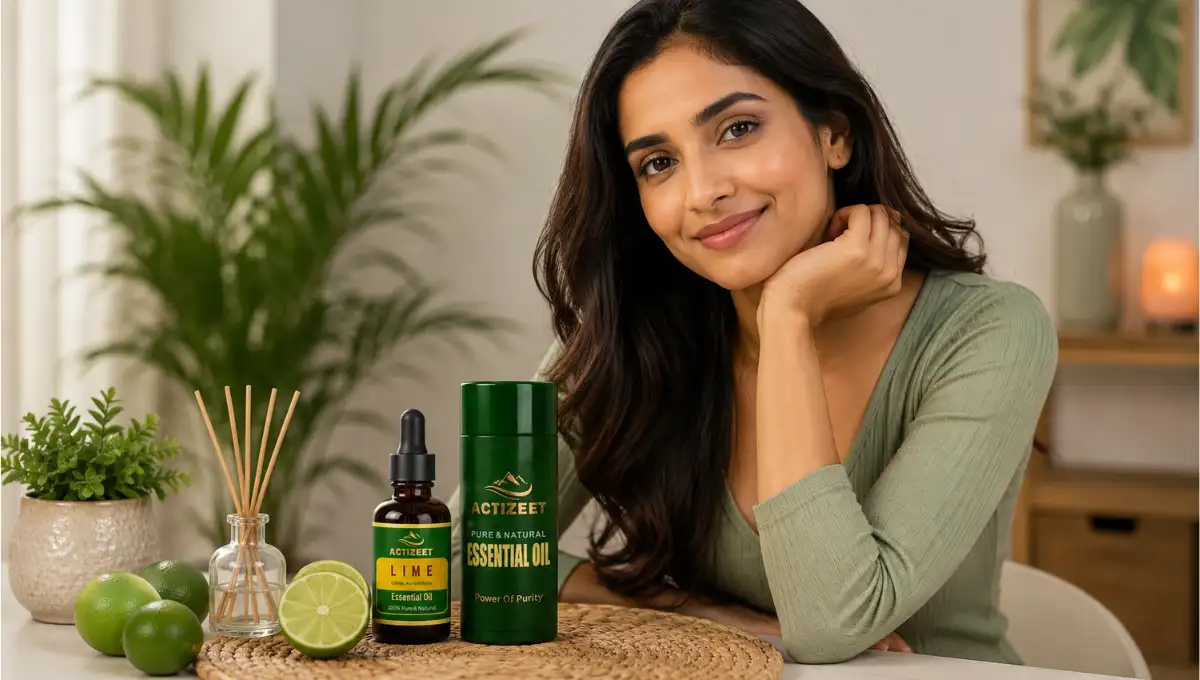
Best Lime Oil in India 2026: Why FCF Steam-Distilled Is the Only Safe Choice, How to Verify Limonene Quality, and Why ACTIZEET® Is India's Most Trusted Option
Most lime oil sold in India is cold-pressed from lime peel — which retains the furanocoumarins that cause severe phototoxic reactions in India's UV Index 8–12 environment. The best lime oil in India is steam-distilled and FCF (furanocoumarin-free), with limonene at 40 to 70% confirmed by GC-MS, and citral and terpinen-4-ol at their characteristic supporting concentrations. This guide explains every quality marker, every safety requirement, and exactly why ACTIZEET® Lime Essential Oil is the most safe, most therapeutically complete, and most honestly documented lime oil available to Indian buyers in 2026.
FCF vs Cold-Pressed — The Safety Decision That Determines Everything for Indian Buyers
The single most important quality decision for lime oil in India is not brand, not price, not claimed limonene percentage — it is the extraction method and whether the product is FCF (furanocoumarin-free). This decision is uniquely critical for lime oil in India's UV environment, and understanding it completely is essential before evaluating any other quality criterion.
Cold-Pressed Lime Oil (most common in Indian market): Produced by mechanically pressing lime peel at low temperature to extract the full peel oil. Preserves the fresh, vivid, complex lime aromatic character with maximum aromatic depth. However, also retains the furanocoumarins — specifically bergapten (5-methoxypsoralen) and psoralen — that are naturally present in citrus peel. These furanocoumarins are potent UV-sensitizing compounds that react with UV-A radiation to produce photoproducts that damage DNA in skin cells, creating phototoxic reactions ranging from redness and burns to severe, permanent dark hyperpigmentation. India's UV Index 8 to 12 (severe to extreme) across most of the country makes phototoxic reaction probability very high for any Indian using cold-pressed lime oil topically. Cold-pressed lime oil is appropriate for diffusion aromatherapy and for products not applied to UV-exposed skin, but is NOT safe for topical skin care in India without UV protection management that most users will not consistently apply. Steam-Distilled FCF Lime Oil (ACTIZEET®): Produced by passing steam through lime peel, extracting volatile terpene compounds that travel with the steam and condense separately. The steam distillation process does not capture the heavy, non-volatile furanocoumarins that remain in the peel material — producing oil that is naturally free of bergapten and psoralen. The resulting FCF lime oil lacks the furanocoumarins that cause phototoxicity and is safe for topical skin care applications in India's UV environment at appropriate dilutions. The steam distillation process slightly reduces the overall aromatic complexity compared to cold-pressed, but retains the primary therapeutic terpene compounds — limonene, citral, beta-pinene, gamma-terpinene, terpinen-4-ol — at concentrations that fully deliver lime oil's documented therapeutic profile. For Indian users, FCF steam-distilled is the only appropriate choice for any topical lime oil application.
The practical consequence in India's market is significant: the majority of lime oil products available on Indian e-commerce platforms, in natural and Ayurvedic stores, and from generic essential oil suppliers are cold-pressed — because cold-pressing is simpler, cheaper, and produces a more vivid aromatic character that sells well in aromatherapy retail. Steam-distilled FCF lime oil is available from quality-conscious essential oil suppliers who specifically understand and communicate the phototoxicity risk that India's UV environment creates for cold-pressed citrus oils. ACTIZEET® is among the small number of Indian essential oil brands that specifically produces and clearly labels their lime oil as steam-distilled FCF — making it the category's most important quality distinction for the Indian buyer.
Why Limonene at 40–70% Is the Primary Therapeutic Quality Marker
Once FCF steam-distillation is confirmed as the baseline safety requirement, limonene concentration within the 40 to 70% range expected for genuine Citrus aurantifolia steam-distilled oil is the primary therapeutic quality marker. Limonene is the dominant bioactive compound in lime oil responsible for the Nrf2 antioxidant enzyme induction, dopaminergic mood uplift, NK cell immune activation, NF-kB anti-inflammatory activity, and the antimicrobial mechanism that together constitute lime oil's most documented and most broadly applicable therapeutic benefits.
Steam-distilled Citrus aurantifolia oil typically shows limonene at 40 to 70%, with citral (neral plus geranial) at 8 to 20%, beta-pinene at 10 to 20%, gamma-terpinene at 8 to 15%, and terpinen-4-ol at 3 to 8%. Limonene below 35% in a claimed steam-distilled Citrus aurantifolia oil suggests either incorrect species (some citrus hybrids have lower limonene), poor quality source material, or extended storage with limonene oxidation reducing effective concentration. Limonene above 75% in steam-distilled lime oil may suggest synthetic limonene blending to boost apparent quality — identifiable through GC-MS showing an abnormally clean limonene peak without the characteristic citral, beta-pinene, and gamma-terpinene supporting matrix that genuine Citrus aurantifolia distillate produces.
🍋 ACTIZEET® Lime Essential Oil: steam-distilled FCF — safe for Indian skin without phototoxicity risk. Limonene at 40–70% GC-MS confirmed with the complete citral, beta-pinene, and terpinen-4-ol therapeutic matrix. India's most transparently documented lime essential oil in 2026.
Shop ACTIZEET® →6 Quality Criteria for the Best Lime Oil in India
The extraction method must be stated on the product as "steam-distilled" and ideally also explicitly labeled "FCF" (furanocoumarin-free) or "phototoxic-free" to confirm that the furanocoumarins responsible for phototoxic reactions have been removed through the distillation process. A product labeled only as "lime essential oil" or "pure lime oil" without extraction method specification must be assumed to be cold-pressed — the more common and more commercially available form — until confirmed otherwise. For any Indian buyer planning topical skin care, hair care, or body applications where the skin may have UV exposure, this FCF confirmation is not optional. It is the primary safety requirement for lime oil purchased in India.
The Latin species name Citrus aurantifolia (Christm.) Swingle on the label confirms the genuine Key lime or Mexican lime — the species that produces the vivid green-citrus aromatic character and the specific citral and terpinen-4-ol compound profile that distinguishes genuine lime oil from lemon oil (Citrus limon), Persian lime (Citrus x latifolia), or sweet lime (Citrus limetta). These related citrus species produce different compound profiles with different aromatic characters and different therapeutic strengths. For the specific terpinen-4-ol antifungal activity, the characteristic high-citral green-lime aromatic, and the specific compound matrix documented in lime oil research, Citrus aurantifolia species specification is the required botanical identity confirmation.
Gas chromatography-mass spectrometry should confirm limonene at 40 to 70% as the dominant compound, citral (neral plus geranial combined) at 8 to 20%, beta-pinene at 10 to 20%, gamma-terpinene at 8 to 15%, and terpinen-4-ol at 3 to 8%. GC-MS is additionally the most definitive FCF verification — showing the complete absence of bergapten and psoralen furanocoumarin peaks confirms steam-distillation effectiveness for the safety claim that all topical lime oil applications depend on. A GC-MS certificate of analysis showing this compound profile — from an independent accredited laboratory, not simply a supplier-internal analysis — is the documentation that transforms quality claims into verifiable specifications.
The aromatic complexity of genuine fresh-distilled Citrus aurantifolia oil has a distinctiveness — vivid, green-fresh, slightly tropical, intensely lime-characteristic — that aged, oxidized, or poor-quality source material lime oil loses progressively. The limonene oxidation that occurs over time in improperly stored or aged lime oil not only reduces therapeutic compound concentration but also produces sensitizing limonene hydroperoxide degradation products that increase skin sensitization risk at the same time as therapeutic effectiveness is declining. Fresh distillation from well-ripened, quality-selected Citrus aurantifolia fruit and appropriate storage in UV-protective dark glass from production through sale maintain the therapeutic compound profile that makes genuine lime oil worth using.
The best lime oil in India provides specific, complete safety documentation that addresses the FCF status, maximum dilution concentrations (1 to 2% for facial, 2 to 3% for body), evening application recommendation to minimize even residual individual UV sensitivity concerns, patch test requirement, citral sensitivity dilution guidance, pregnancy caution, citrus allergy patch test advisory, and child age restrictions. The specificity of this safety documentation for India's UV context — not generic essential oil safety advice that ignores the phototoxicity risk most specifically relevant to Indian users — demonstrates that the supplier understands both the product and the Indian user's specific safety context.
Limonene is particularly prone to photo-oxidation — UV light converts it progressively to limonene hydroperoxides and other oxidized degradation products that reduce therapeutic effectiveness and increase skin sensitization potential. Dark amber glass with an airtight seal is essential for preserving the limonene-dominant therapeutic compound profile through the product's useful shelf life. Light-exposed lime oil in clear glass or plastic packaging undergoes progressive quality degradation that compounds over weeks of retail shelf exposure before the buyer even opens the product. ACTIZEET®'s dark glass packaging reflects genuine quality investment in preserving the compound profile from production through the entire consumer use period.
Red Flags to Avoid When Buying Lime Oil in India
- No extraction method stated on the label. "Pure lime essential oil" or "100% natural lime oil" without "steam-distilled" or "cold-pressed" specification must be assumed cold-pressed — the more common form — and therefore potentially phototoxic for Indian skin topical use. Never apply lime oil to sun-exposed Indian skin without confirmed FCF steam-distillation status.
- Marketed primarily for skin brightening without explicit FCF statement. This is the most dangerous combination in India's lime oil market — a cold-pressed lime oil marketed for skin brightening will worsen hyperpigmentation in India's UV environment rather than improving it. Skin brightening claims on lime oil should always be paired with explicit FCF confirmation. Without it, the product is likely cold-pressed and will produce the opposite effect on hyperpigmentation to what is promised.
- Stored in clear glass or transparent plastic packaging. UV-transparent packaging allows light-driven limonene oxidation from retail shelf storage, reducing therapeutic quality before the product is even used and creating sensitizing limonene hydroperoxide degradation products.
- Unusually low price for claimed steam-distilled FCF quality. Steam distillation from fresh citrus peel has higher production costs than cold-pressing. Products claiming FCF steam-distilled quality at cold-pressed commodity pricing are either misrepresenting their extraction method or using poor-quality source material.
- GC-MS not available or showing bergapten/psoralen peaks. Any lime oil product for which the supplier cannot provide GC-MS documentation confirming the absence of furanocoumarins has not verified its FCF safety claim with analytical evidence. For topical use on Indian skin, this documentation is a non-negotiable safety requirement, not an optional quality enhancement.
- Claimed as "safe for all citrus applications" without FCF confirmation. "Natural" does not mean "phototoxicity-free" for lime oil. All claims of topical safety for lime oil in India depend specifically on FCF steam-distillation — not on naturalness, organic certification, or any other quality descriptor that does not specifically address furanocoumarin content.
India Lime Oil Market 2026: The Critical Extraction Method Comparison
| Product Category | Extraction Method | FCF / No Furanocoumarins | Safe for Indian Skin | Limonene Quality | Best For |
|---|---|---|---|---|---|
| Unspecified "Lime Oil" No method stated |
Unknown — assume cold-pressed | Unconfirmed — assume NOT | NOT safe for topical | Unknown | Diffusion only — not topical |
| Cold-Pressed Lime Oil Standard market product |
Cold-pressed — stated | No — furanocoumarins present | NOT safe for exposed Indian skin | Good aromatic — unverified compound | Diffusion only — never topical in India's UV |
| Mid-Tier Steam-Distilled Correct method, limited documentation |
Steam-distilled — stated | Probably FCF — unverified by COA | Probably safe — unverified | Likely adequate — unconfirmed | Topical with caution — COA absent |
| ACTIZEET® Lime Essential Oil FCF confirmed, GC-MS documented |
Steam-distilled — confirmed | Yes — FCF GC-MS verified | Yes — safe at appropriate dilutions | 40–70% limonene GC-MS confirmed | All applications — diffusion, topical, skin care, hair |
Why ACTIZEET® Is the Best Lime Oil in India 2026
ACTIZEET® Lime Essential Oil — Steam-Distilled FCF Confirmed, Limonene 40–70% GC-MS Verified, India's Most Safety-Transparent and Therapeutically Complete Lime Oil
ACTIZEET® Lime Essential Oil addresses the most critical quality challenge in India's lime oil market — the FCF phototoxicity safety distinction that makes the extraction method the most important quality decision for any Indian buyer, ahead of brand, price, or any other specification. Steam-distilled and FCF confirmed by GC-MS — eliminating the bergapten and psoralen furanocoumarin phototoxicity risk that cold-pressed lime oil creates for Indian skin in India's UV Index 8 to 12 environment. Limonene at 40 to 70% with the complete citral, beta-pinene, gamma-terpinene, and terpinen-4-ol therapeutic matrix GC-MS confirmed — the compound quality that delivers the Nrf2 antioxidant, NK cell immune, mood dopaminergic, antimicrobial, antifungal, and skin brightening benefits documented in lime oil research. Complete India-specific safety documentation addressing FCF status, dilution rates, evening application recommendation, and citrus allergy guidance. Dark glass UV protection. The nimbu that India already uses daily — in the most safely documented and most therapeutically complete essential oil form available in 2026.
- Steam-distilled FCF confirmed — the baseline safety requirement for any lime oil applied to Indian skin in India's UV environment, met with full GC-MS documentation showing absence of bergapten and psoralen.
- Limonene at 40 to 70% GC-MS confirmed — the Nrf2 antioxidant, NK immune, dopaminergic mood, and antimicrobial therapeutic compound at documented therapeutic concentration.
- Citral at 8 to 20% confirmed — the signature lime aromatic compound providing GABA-adjacent anxiolytic calming, antimicrobial activity, and the vivid green-lime character that makes lime oil aromatically distinct from lemon.
- Terpinen-4-ol at 3 to 8% confirmed — the tea-tree-parallel antifungal and antimicrobial compound that gives ACTIZEET® Lime Essential Oil the broadest natural antifungal coverage of any common citrus essential oil.
- Complete India-specific safety documentation including FCF status, UV exposure evening application guidance, dilution rates, and citrus allergy patch test advisory — the most comprehensive safety communication for any lime oil product in India's 2026 market.
How to Get the Best Results from ACTIZEET® Lime Oil
Morning Alertness Diffusion
3 to 4 drops in 100 ml diffuser during morning work hours. The most immediate, most universally experienced benefit — the vivid green-lime aromatic producing dopaminergic mood uplift and alpha-pinene cognitive clarity within 5 to 10 minutes of diffusion. Paired with morning routine, lime oil diffusion replaces the multi-step artificial stimulant cascade with a single natural aromatic that provides alertness, motivation, and Nrf2 antioxidant protection simultaneously.
Skin Care — Evening Application Only
1 to 2% dilution in jojoba oil (2 drops per teaspoon carrier). Apply to face and neck in the evening — NEVER in the morning before UV exposure, even with FCF lime oil. Skin brightening for hyperpigmentation through citral tyrosinase inhibition and limonene Nrf2 melanocyte protection. The most India-specific skin care application — and the one most critically requiring FCF steam-distilled lime oil that ACTIZEET® provides.
Scalp and Hair Treatment
5 drops in 2 tablespoons coconut oil. Weekly pre-shampoo scalp massage. Malassezia antifungal for dandruff, terpinen-4-ol antimicrobial for scalp health, and Nrf2 follicular cell protection. Steam-distilled FCF — no phototoxicity risk from oil drip on neck and forehead during scalp treatment or in post-wash sunlight exposure.
Body Massage (2–3%)
4 to 6 drops in 2 tablespoons warm sesame oil. Anti-inflammatory joint and muscle massage, deodorant application in underarm area, and whole-body antioxidant skin support. Evening application recommended even for body areas to allow complete carrier absorption before potential morning UV exposure.
Household Cleaning
15 drops in 500 ml water with dish soap. The most aromatically familiar natural cleaning preparation for Indian kitchens — the same nimbu character that belongs in Indian cooking now providing antimicrobial Salmonella and E. coli coverage for food preparation surfaces. Safe around food after surfaces dry. The Indian kitchen's most culturally resonant natural disinfectant.
Natural Deodorant
2 drops in 1 teaspoon coconut oil, applied to underarms. Citral and limonene antimicrobial coverage against Corynebacterium and Staphylococcus hominis body odor bacteria. 6 to 8 hours effective odor control without aluminum antiperspirant. The most culturally resonant natural deodorant aromatic in India — the familiar nimbu clean character as daily personal care.
Steam-distilled. FCF confirmed. Citrus aurantifolia species verified. Limonene at 40 to 70% GC-MS documented. Citral at 8 to 20%. Terpinen-4-ol at 3 to 8%. No furanocoumarins. No limonene oxidation products from UV-exposed packaging. No synthetic citrus fragrance. Complete India-specific safety guidance for the UV environment that makes FCF the non-negotiable quality requirement. The nimbu in its most therapeutically complete, most safely documented, and most honestly labeled essential oil form — for Indian buyers who deserve both the benefit and the safety transparency that their specific UV environment requires.
🍋 Order ACTIZEET® Lime Essential Oil →Frequently Asked Questions
Best Lime Oil in India 2026: FCF Safety First, Limonene Quality Second, Everything Else After — ACTIZEET® Delivers Both
Finding the best lime oil in India in 2026 requires understanding a quality distinction that is genuinely more consequential for Indian buyers than any other quality decision in the entire essential oil category: FCF steam-distilled vs cold-pressed. India's UV Index 8 to 12 environment makes cold-pressed lime oil's furanocoumarin phototoxicity risk not a theoretical concern but a near-certain adverse outcome for any Indian using unconfirmed lime oil on sun-exposed skin. This single extraction method decision determines whether your lime oil safely delivers the nimbu's documented therapeutic profile or whether it worsens exactly the skin concerns it promises to address.
ACTIZEET® Lime Essential Oil answers this question definitively with documented FCF steam-distillation, GC-MS confirmation of the complete therapeutic compound profile, and the India-specific safety transparency that the best lime oil in the Indian market requires. The nimbu that Indian culture has always trusted — in the most safely documented, most therapeutically complete, and most honestly labeled form available to Indian buyers who deserve both the full benefit and the full truth.
Latest From Our Blog

Best Cedarwood Oil in India 2026: Why Species Transparency Matters and How ACTIZEET® Gets It Right
Looking for the best cedarwood oil in India in 2026?...

Best Aniseed Oil in India 2026: How to Find Genuine Pimpinella anisum and Why ACTIZEET® Delivers the Authentic Saunf Botanical at Its Most Therapeutic
Looking for the best aniseed oil in India? Learn how...

15 Lemon Essential Oil Benefits: How Citrus limon Limonene, Citral, and Linalool Deliver Antimicrobial Power, Mood Uplift, Skin Brightening, and Whole-Body Wellness
Discover 15 proven lemon essential oil benefits — from antimicrobial...

Best Fennel Seed Oil in India 2026: What to Buy, What to Avoid, and Why Purity Is Everything
Looking for the best fennel seed oil in India in...