
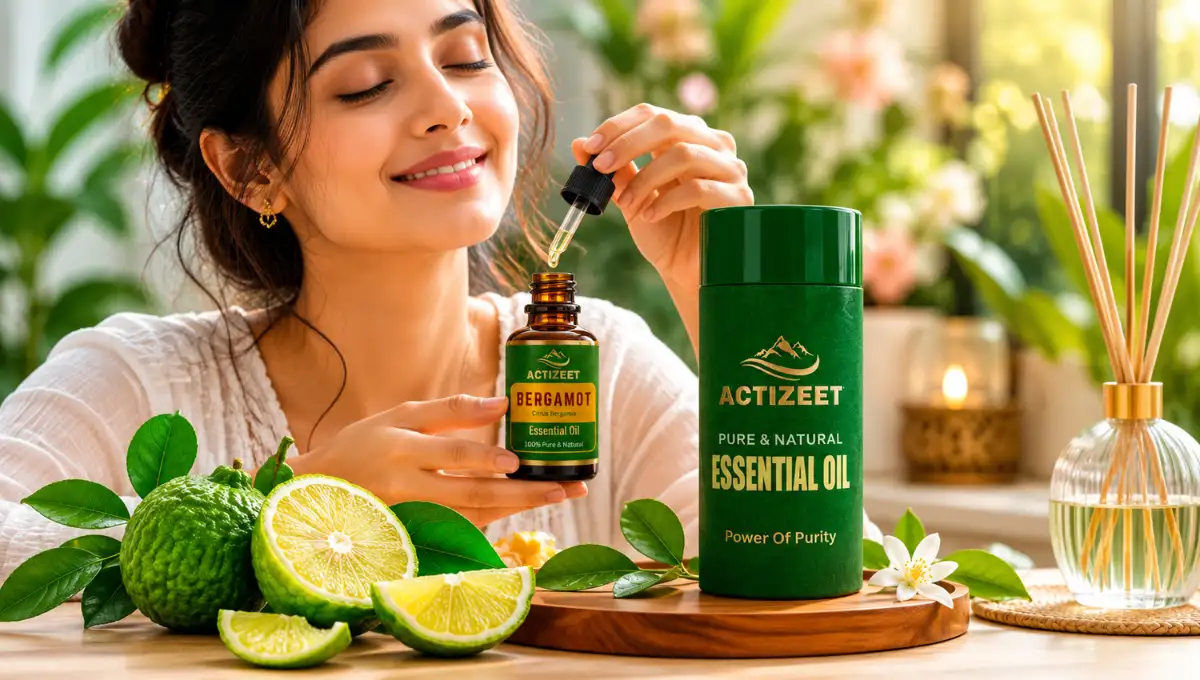
Best Bergamot Oil in India 2026: Why FCF Grade Is Non-Negotiable and How ACTIZEET® Gets Every Quality Standard Right
Bergamot oil has a unique and India-specific quality challenge that no other essential oil in this guide series shares: the phototoxicity risk from bergapten furanocoumarins in regular bergamot oil makes the FCF (bergapten-free) grade specification not just a quality preference but a genuine skin safety requirement for anyone using bergamot oil topically in India's high-UV climate. Combined with the usual challenges of synthetic citrus fragrance substitution and carrier oil dilution, this makes choosing the best bergamot oil in India a more consequential decision than most essential oil purchases. ACTIZEET® is the answer — here is why.
Most Indians have encountered bergamot before they ever search for bergamot essential oil — it is the citrus-floral aroma of Earl Grey tea, one of the most widely consumed flavored teas in India and globally. But the bergamot essential oil that Indian buyers are increasingly seeking for aromatherapy, skin care, anxiety management, and mood support is a different context entirely from the tea flavoring familiar from tea tins, and in that essential oil context, bergamot has a quality consideration that is more urgent and more India-specific than any other oil in this guide series.
The consideration is bergapten — a naturally occurring furanocoumarin in bergamot rind oil that causes severe phototoxic skin reactions when UV-exposed skin is treated with the compound. In the UV environment of northern European countries (where bergamot's therapeutic use in aromatherapy was largely codified in the 20th century), bergapten's phototoxicity risk was recognized and managed with appropriate sun avoidance guidance. In India's substantially higher UV environment — where daily outdoor activities expose Indian skin to UV intensities that make even winter sunshine in most Indian cities more intense than peak summer sunshine in northern England — the bergapten phototoxicity risk is dramatically more serious and cannot be managed by simple sun avoidance guidance for most Indian users who cannot avoid outdoor UV exposure in daily life.
The solution — FCF (furocoumarin-free) bergamot oil, from which bergapten has been removed — exists and is the industry standard for topical bergamot oil use in high-UV environments. The problem for Indian buyers in 2026 is that not all bergamot oil products sold in India specify FCF grade, and buying regular bergamot oil for topical skin use in India's climate is a genuine safety risk that informed purchasing can entirely avoid. This guide tells you everything you need to know.
Regular bergamot essential oil contains bergapten — a furanocoumarin that causes severe phototoxic burns and permanent hyperpigmentation when bergapten-treated skin is exposed to UV light. In India's high-UV climate, this risk is dramatically more serious than in northern European markets where most aromatherapy bergamot guidance was originally written. For ANY topical skin use of bergamot oil in India, you must use FCF (bergapten-free) grade bergamot oil only. FCF bergamot has bergapten removed to below detection limits — all therapeutic benefits of bergamot's linalyl acetate, limonene, and linalool compounds are preserved; only the skin-burning bergapten compound is removed. ACTIZEET® Bergamot Essential Oil is FCF grade — verified by GC-MS analysis confirming bergapten absence. Always verify FCF status before purchasing or using any bergamot oil on skin.
FCF vs Regular Bergamot Oil — The Full Explanation Every Indian Buyer Needs
Understanding the FCF distinction requires understanding what bergapten actually does and why its removal matters specifically for Indian buyers in ways it may matter less for buyers in lower-UV environments.
What Bergapten Is and Why It Is in Bergamot Oil
Bergapten (5-methoxypsoralen, 5-MOP) is a naturally occurring furanocoumarin compound that the bergamot fruit produces as part of its natural defense chemistry. It is found in the rind of the bergamot fruit along with the aromatic terpene compounds that give bergamot oil its therapeutic character. In moderate amounts, bergapten itself has some anti-inflammatory and antiproliferative research interest — the compound is studied in dermatology for potential psoriasis applications at clinically controlled concentrations. The problem is its photosensitizing mechanism: bergapten intercalates with DNA in skin cells and, when activated by UV radiation (specifically UVA wavelengths), forms covalent crosslinks with DNA strands in skin cells that cause an inflammatory cascade equivalent to a severe localized UV burn.
The UV Intensity Difference Between India and Europe
Most early aromatherapy guidance about bergamot's phototoxicity was developed in European contexts where the practical risk was manageable — a European user who applied bergamot oil to skin and then went outside in October in England was exposed to UV Index 1 to 2 conditions where even bergapten-sensitized skin might not react severely. An Indian user who applies regular bergamot oil to their face as a skin care preparation and then goes about a normal Indian morning in March — outdoor market, school run, morning commute — is exposed to UV Index 8 to 12 conditions where the bergapten-sensitized skin can suffer severe burns within minutes of UV exposure.
| Feature | Regular Bergamot Oil (WITH Bergapten) | FCF Bergamot Oil (WITHOUT Bergapten) |
|---|---|---|
| Bergapten content | 0.3–0.5% — strongly phototoxic at India UV levels | Below detection limit (<0.001%) — phototoxicity risk eliminated |
| Linalyl acetate | 25–45% — full therapeutic content | 25–45% — identical therapeutic content preserved |
| Limonene | 25–45% — full therapeutic content | 25–45% — identical therapeutic content preserved |
| Linalool | 5–20% — full therapeutic content | 5–20% — identical therapeutic content preserved |
| Aroma character | Full citrus-floral bergamot character | Essentially identical — bergapten is not a primary aromatic compound |
| Therapeutic benefits | Full anxiolytic, antidepressant, antimicrobial, skin care benefits | Identical — FCF removal does not affect therapeutic compound profile |
| Safe for India topical use? | NO — severe phototoxicity risk in India's UV environment | YES — appropriate for topical skin use with normal dilution precautions |
| Safe for diffusion only? | Yes — aromatic diffusion without skin contact is safe | Yes — plus all topical applications |
The key practical takeaway: FCF bergamot oil contains every single therapeutic compound that makes bergamot oil valuable — all the anxiolytic linalyl acetate, all the mood-uplifting limonene, all the GABA-A anxiolytic linalool — while eliminating only the bergapten compound that provides no therapeutic benefit in aromatherapy and topical applications but creates the phototoxicity risk. FCF is not a compromise; it is simply the correct form of bergamot oil for the world's highest-UV-intensity populated regions, which includes virtually all of India.
Why Quality Beyond FCF Still Matters — The Three Additional Quality Concerns
FCF specification is necessary but not sufficient for the best bergamot oil in India. Three additional quality concerns affect whether you receive genuine therapeutic benefits from your bergamot oil beyond the baseline FCF safety requirement.
Challenge 1 — Synthetic Citrus Fragrance Substitution
Bergamot has one of the most imitable aromatic profiles of any essential oil — synthetic limonene and linalool are among the most widely produced and least expensive aroma chemicals globally, and a synthetic linalool-limonene blend in a carrier oil creates an aroma that most buyers cannot distinguish from genuine cold-pressed bergamot at initial encounter. The synthetic substitute provides none of the anxiolytic linalyl acetate (which smells similar enough to synthetic linalool that the aroma check fails), none of the gamma-terpinene antimicrobial activity, none of the beta-pinene bronchodilatory contribution, and none of the complex minor compound matrix of genuine Calabrian bergamot that creates the aromatic character connoisseurs recognize as distinctly bergamot rather than generic citrus-floral.
Challenge 2 — Carrier Oil Dilution
Genuine bergamot essential oil's moderate production cost (less expensive than rose or jasmine but more expensive than lavender or peppermint) creates economic incentive for carriers to add carrier oil dilution — stretching a smaller quantity of genuine bergamot into a larger volume that appears to be pure oil. A 5% bergamot-in-jojoba preparation smells identifiably like bergamot but contains only 5% of the linalyl acetate, limonene, and linalool concentrations needed for meaningful therapeutic activity at standard dilution ratios.
Challenge 3 — Non-Calabrian Origin Substitution
Genuine Citrus bergamia grown in Calabria, Italy — where 80 to 90% of world bergamot is produced — has a specific compound profile (linalyl acetate at 25 to 45%, limonene at 25 to 45%) that is the basis of bergamot's therapeutic reputation. Bergamot grown in other regions (Ivory Coast, Brazil, Argentina) or other Citrus species with similar aromatics may be sold under the bergamot name with different compound ratios that provide different therapeutic activity levels. GC-MS verification of the linalyl acetate content specifically confirms both species identity and appropriate therapeutic compound concentration.
🍋 ACTIZEET® Bergamot Essential Oil: FCF grade verified by GC-MS, bergapten absent, linalyl acetate at 25 to 45% confirmed, genuine Citrus bergamia from verified Italian Calabrian origin — the complete quality answer for Indian buyers in 2026.
Shop ACTIZEET® →6 Quality Criteria for the Best Bergamot Oil in India
The first, most critical, and non-negotiable quality criterion for any bergamot oil purchased for topical use in India is explicit FCF grade declaration. The label must state "FCF," "furocoumarin-free," or "bergapten-free" clearly — not implied by the product description, not assumed from a general "safe for skin use" claim, but explicitly stated as part of the product specification. A bergamot oil labeled without explicit FCF status cannot confirm that bergapten has been removed, and using it topically in India's UV environment carries genuine risk.
The FCF specification also requires analytical verification rather than just a label claim — the label should indicate that FCF status was confirmed by GC-MS analysis showing bergapten below detection threshold. Any supplier who cannot confirm FCF status through accessible GC-MS data is making a label claim they cannot verify analytically. ACTIZEET® provides GC-MS documentation confirming bergapten is below detection limits in their bergamot oil, giving buyers the analytical confidence that the FCF label claim is backed by actual compound testing.
Genuine bergamot essential oil comes from Citrus bergamia Risso and Poit. — a specific citrus hybrid grown primarily in the Calabria region of southern Italy. This species specification confirms that you are receiving genuine bergamot rather than a cheaper citrus substitute, and the Calabrian origin confirmation establishes that the linalyl acetate-dominant compound profile characteristic of authentic Italian bergamot is what you are purchasing. Italian Calabrian bergamot's specific linalyl acetate content (25 to 45%) is what distinguishes bergamot from other citrus oils and what produces the dual citrus-anxiolytic therapeutic profile that makes it different from all other citrus essential oils.
For buyers who do not specifically need Italian-origin bergamot, bergamot from Ivory Coast (the second-largest producer) or other origins is also legitimate Citrus bergamia with broadly similar but slightly different compound profiles. The key is that the species name Citrus bergamia is specified — distinguishing genuine bergamot from other Citrus species that might be sold under the generic "bergamot" name for their superficial aromatic similarity.
Like all citrus essential oils, genuine bergamot essential oil is produced by cold-pressing the rind of the bergamot fruit — a mechanical process that squeezes the aromatic oil from the rind cells without heat, preserving the complete volatile compound profile including the heat-sensitive minor aromatic compounds that distinguish genuine cold-pressed bergamot from steam-distilled or synthetic preparations. Cold-pressed bergamot should be specified as the extraction method on the label or in the product documentation.
Some bergamot products use steam distillation — which is a different product from cold-pressed bergamot oil with a different (typically higher linalyl acetate, lower limonene) compound profile. Both can be legitimate therapeutic products, but the difference affects the aromatic character and the relative balance of anxiolytic versus mood-uplifting mechanisms. For most therapeutic applications seeking bergamot's characteristic citrus-floral dual mechanism, cold-pressed bergamot rind oil is the conventional and most broadly researched form.
GC-MS analysis for genuine FCF bergamot oil must confirm two things simultaneously: the presence of linalyl acetate at 25 to 45% of total composition (confirming genuine Citrus bergamia botanical identity and appropriate therapeutic compound concentration), and the absence of bergapten at below-detection-limit levels (confirming FCF grade and topical skin safety for India's UV environment). These two GC-MS confirmations together provide the complete quality verification for bergamot oil — species authenticity through linalyl acetate, and safety verification through bergapten absence.
A GC-MS profile showing only high limonene without meaningful linalyl acetate suggests either a different citrus species or a very poor quality bergamot sample. A GC-MS profile with appropriate linalyl acetate but detectable bergapten is genuine bergamot but is not FCF — safe for diffusion only, not for topical application in India. Only the combination of appropriate linalyl acetate content and confirmed bergapten absence provides the full quality-and-safety verification that the best bergamot oil in India requires.
Genuine bergamot essential oil sold as a pure essential oil contains only the cold-pressed rind oil from Citrus bergamia fruit — no carrier oil added for volume, no synthetic limonene or linalyl acetate added to supplement a weak or off-grade bergamot batch, and no other citrus oils blended in to modify the aromatic character. The paper evaporation test provides a basic carrier oil check — pure bergamot essential oil evaporates from paper completely without leaving a permanent oily mark. The evaporation should also leave a trace of the characteristic bergamot aromatic residue rather than evaporating cleanly without scent, as synthetic fragrance blends with lower boiling point compounds tend to do.
Purity verification through GC-MS showing the expected compound ratios — not just high limonene that could be synthetic, but the specific linalyl acetate-limonene balance with supporting beta-pinene, gamma-terpinene, linalool, and minor aromatic compounds — confirms genuine botanical cold-pressed bergamot oil. The minor compound matrix is the authenticity fingerprint that synthetic constructions cannot replicate at the correct ratios simultaneously.
Bergamot oil's limonene and linalyl acetate compounds undergo photo-oxidative degradation under UV light, with limonene particularly susceptible to UV-driven oxidative conversion to compounds that can become skin sensitizers. This makes UV-protective amber glass packaging especially important for bergamot oil — the degradation products of photo-oxidized limonene are themselves potential skin sensitizers that add a new sensitization risk to oil that should be safe at appropriate dilution when fresh and properly stored.
For a product being sold specifically for its skin care benefits (FCF bergamot for acne, eczema, and complexion care) and for its anxiolytic and antidepressant aromatic activity (both of which require intact linalyl acetate and linalool at their expected concentrations), UV-protective amber glass is not optional packaging detail — it is the quality standard that ensures the therapeutic compound profile confirmed by GC-MS testing remains intact through the weeks or months between production and buyer use.
Red Flags: What to Avoid When Buying Bergamot Oil in India
- No explicit FCF or furocoumarin-free or bergapten-free declaration on the label. This is the most critical red flag for bergamot specifically — the absence of explicit FCF declaration cannot be assumed to mean FCF. The supplier may not know, may not have tested for bergapten, or may be selling regular bergamot oil. In any of these cases, using the product topically in India carries genuine phototoxicity risk.
- FCF claimed on the label but no GC-MS data available to verify it. FCF can be falsely claimed as a marketing attribute by suppliers who have not actually had their bergamot oil tested for bergapten. The only reliable FCF verification is GC-MS data from an accredited laboratory showing bergapten below detection threshold. A label claim without accessible analytical backing is insufficient for India's UV environment.
- Aroma that is one-dimensionally "citrus lemon" without the characteristic floral-complex bergamot depth. Genuine bergamot has a distinctive aromatic character that clearly differs from lemon, lime, or sweet orange — the linalyl acetate-limonene combination creates a simultaneously citrus-bright and floral-deep complexity. Products that smell like lemon or generic citrus without the distinguishing bergamot floral complexity may be cheaper citrus oils substituted under the bergamot name.
- Very large volumes at unusually low prices. Genuine bergamot essential oil has a moderate production cost — less expensive than rose but more expensive than lavender. Products offering large volumes at prices that imply very low per-milliliter costs are often synthetic fragrance preparations or heavily diluted genuine oil.
- Clear glass or plastic packaging. Given limonene's photo-oxidative sensitivity and the skin sensitization risk of oxidized limonene compounds, UV-protective amber glass is the appropriate minimum packaging standard for any bergamot oil being sold for therapeutic use.
- No botanical species name (Citrus bergamia) on the label. Without the Latin species name, you cannot confirm this is genuine bergamot rather than another citrus species with a similar aromatic profile. This is standard label transparency that any genuine essential oil supplier can and should provide.
India Bergamot Oil Market 2026: What You Are Choosing Between
| Market Category | Typical Price | FCF Declared | Bergapten Tested Absent | Linalyl Acetate Verified | Safe for India Topical Use |
|---|---|---|---|---|---|
| Synthetic Citrus Fragrance Linalool + limonene in carrier |
₹100 – ₹300 | N/A — not botanical | No bergapten — safe | No — synthetic only | Safe but no therapeutic value |
| Regular Bergamot (Non-FCF) Genuine oil, bergapten present |
₹200 – ₹600 | Not FCF — phototoxic | No — bergapten present | Yes — genuine bergamot | NOT safe for India topical use |
| Mid-Tier FCF Bergamot FCF claimed, unverified by GC-MS |
₹350 – ₹900 | Label claims FCF | Not independently verified | Often — unconfirmed | Possibly — unverified |
| ACTIZEET® FCF Bergamot GC-MS verified FCF, Citrus bergamia |
Premium tier | Yes — explicitly FCF | Yes — GC-MS confirmed | Yes — 25–45% confirmed | Yes — India safe, verified |
The "NOT safe for India topical use" row for regular non-FCF bergamot is the most important column in this comparison specifically for Indian buyers. Regular bergamot is a genuinely high-quality botanical product that is appropriate for diffusion-only use in India — it is not a fraudulent product. But using it topically in India's UV environment represents a risk that FCF bergamot eliminates entirely. The mid-tier FCF category is concerning specifically because an unverified FCF claim provides false safety assurance — a buyer who thinks they have FCF bergamot but has not verified it through GC-MS may use the product topically in full confidence while the bergapten phototoxicity risk is not actually eliminated.
Why ACTIZEET® Is the Best Bergamot Oil in India in 2026
ACTIZEET® Bergamot Essential Oil — FCF Verified by GC-MS, Citrus bergamia Confirmed, Linalyl Acetate 25–45%, India-Safe for Topical Use
ACTIZEET® Bergamot Essential Oil addresses every quality criterion that separates safe, genuine, therapeutic bergamot oil from the products that India's market contains that are either phototoxically unsafe for topical use (regular non-FCF bergamot), therapeutically empty (synthetic citrus fragrance), or unverified despite FCF label claims (mid-tier brands without GC-MS documentation). FCF explicitly declared. Bergapten confirmed absent by GC-MS. Citrus bergamia botanical species specified. Calabrian Italian origin. Linalyl acetate at 25 to 45% confirmed. Limonene at 25 to 45% confirmed. Cold-pressed rind extraction. 100% pure and undiluted. UV-protective amber glass. The complete answer to the best bergamot oil in India question in 2026.
Why ACTIZEET® Leads India's Bergamot Market
- FCF declared and GC-MS-verified — not just a label claim. ACTIZEET® provides accessible GC-MS data showing bergapten below detection limits in their bergamot oil. This analytical verification is the difference between an FCF claim you can trust and one that provides false safety assurance in India's UV environment.
- Linalyl acetate at 25 to 45% confirmed — genuine Citrus bergamia therapeutic profile. The compound that distinguishes bergamot from all other citrus oils — the linalyl acetate that provides the GABA-A anxiolytic and antidepressant mechanism — is present at its characteristic Calabrian bergamot concentration, confirming both species authenticity and therapeutic compound adequacy.
- Complete India-specific product communication. ACTIZEET® specifically communicates the FCF grade, the phototoxicity risk of non-FCF bergamot, and the appropriate use guidance for Indian buyers using bergamot oil in a high-UV environment. This India-context awareness in their product communication distinguishes them from suppliers who present European-market aromatherapy guidance without adapting for India's significantly different UV reality.
- Cold-pressed Citrus bergamia from verified Italian Calabrian origin. The botanical source that has been producing the world's benchmark bergamot for centuries, cold-pressed using the method that preserves the complete compound complexity — including the minor aromatic compounds that distinguish genuine Calabrian bergamot from substitutes and synthetics.
- 100% pure and undiluted — FCF bergamot only, no carrier additions. The complete therapeutic compound concentrations that genuine bergamot oil provides, giving buyers control over their own dilution for each specific application rather than receiving pre-diluted material at pure-product pricing.
- UV-protective amber glass preventing limonene photo-oxidation and sensitization. Fresh, intact linalyl acetate and limonene at their verified concentrations, protected from the photo-oxidative degradation that would reduce therapeutic activity and create new sensitization compounds from oxidized limonene metabolites.
Getting the Most from ACTIZEET® FCF Bergamot Essential Oil
Anxiety and Mood Diffusion
Add 4 to 5 drops to a 100 ml diffuser for 30 to 60 minutes. The dual GABA-A anxiolytic linalyl acetate and dopaminergic mood-uplifting limonene creates the most therapeutically balanced natural anxiety and mood support aromatic environment available. The FCF specification is irrelevant for diffusion — both regular and FCF bergamot are equally safe aromatically.
Acne Face Oil (FCF Required)
Dilute 2 drops FCF bergamot in 1 tablespoon jojoba oil. Apply to clean skin as a daily face oil targeting oily, acne-prone skin. Antimicrobial against acne bacteria, anti-inflammatory, astringent for pore control — with the pleasant fresh citrus-floral aroma that makes bergamot one of the most enjoyable anti-acne skin care oils. Possible only with FCF grade.
Sleep Support
Diffuse 3 drops bergamot with 3 drops lavender for 20 to 30 minutes before bed. The linalyl acetate sedative from both oils with bergamot's additional dopaminergic mood-brightening creates the relaxed positive calm that facilitates natural sleep onset — better than purely sedating oils that create a heavy pre-sleep state.
Natural Perfume (FCF Required)
Blend 4 drops FCF bergamot with 2 drops sandalwood and 1 drop jasmine in 1 tablespoon jojoba oil. A natural citrus-floral-woody personal fragrance of genuine sophistication — the fresh Italian bergamot top note with sandalwood's grounding depth. Safe for daily skin wear with FCF grade in India's climate.
Natural Mouthwash
Add 1 to 2 drops to 100 ml warm water. Swish 60 seconds, spit, never swallow. FCF or regular bergamot is equally appropriate for mouthwash use where bergapten's phototoxicity is not relevant — but the fresh citrus-floral character of bergamot makes this one of the most pleasant natural oral hygiene preparations available for daily use.
Scalp Treatment (FCF Required)
Add 6 drops FCF bergamot to 2 tablespoons coconut oil. Massage into scalp, leave 30 minutes, wash out. Antifungal Malassezia dandruff control, sebum regulation for oily scalps, fresh citrus-floral hair fragrance — all delivered safely with FCF grade for India's outdoor UV exposure during scalp treatment.
FCF grade verified by GC-MS. Bergapten confirmed absent below detection limits. Citrus bergamia from Calabrian Italian origin. Cold-pressed rind extraction. Linalyl acetate at 25 to 45% confirmed. Limonene at 25 to 45% confirmed. 100% pure and undiluted. UV-protective amber glass. Complete India-specific phototoxicity safety information provided. The best bergamot oil in India in 2026 — because it is the only one that guarantees you receive genuine therapeutic bergamot that is actually safe to use on Indian skin in India's UV environment.
🍋 Order ACTIZEET® Bergamot Essential Oil →Frequently Asked Questions
The Best Bergamot Oil in India 2026: FCF Verified, Botanically Genuine, India-Safe
The best bergamot oil in India in 2026 answers three questions simultaneously. Is it FCF (bergapten-free) with GC-MS-verified bergapten absence — confirmed safe for topical skin use in India's high-UV environment without phototoxicity risk? Is it genuine cold-pressed Citrus bergamia with linalyl acetate at 25 to 45% confirmed — not synthetic fragrance or a different citrus species? And is it 100% pure and undiluted — not pre-diluted in carrier oil at pure-product pricing?
ACTIZEET® Bergamot Essential Oil answers all three questions with full documentation. FCF grade verified by GC-MS. Citrus bergamia from Calabrian Italian origin with linalyl acetate at 25 to 45% confirmed. Pure and undiluted in UV-protective amber glass. The anxiolytic linalyl acetate, the mood-uplifting limonene, the GABA-A calming linalool — all at their confirmed therapeutic concentrations, all delivered safely in India's UV environment because the one compound that would make them dangerous in that environment has been rigorously removed and independently verified as absent. That is what makes ACTIZEET® the best bergamot oil in India in 2026.
Latest From Our Blog

Best Lavender Oil in India 2026: A Complete Buyer’s Guide to Pure, Authentic Lavandula angustifolia Essential Oil
Looking for the best lavender oil in India in 2026?...

15 Neroli Essential Oil Benefits: How Orange Blossom’s Linalool, Limonene, and Nerolidol Deliver PMC-Confirmed Anxiety Relief, Antidepressant Action, and Skin-Renewing Power
Discover 15 neroli essential oil benefits from PMC RCTs confirming...

Best Cassia Oil in India 2026: How to Find Genuine Cinnamomum cassia and Why ACTIZEET® Delivers the Dalchini Botanical at Its Most Therapeutic
Looking for the best cassia oil in India? Learn how...

15 Turmeric Essential Oil Benefits That Go Far Beyond the Kitchen Spice
Discover 15 powerful turmeric essential oil benefits backed by modern...