
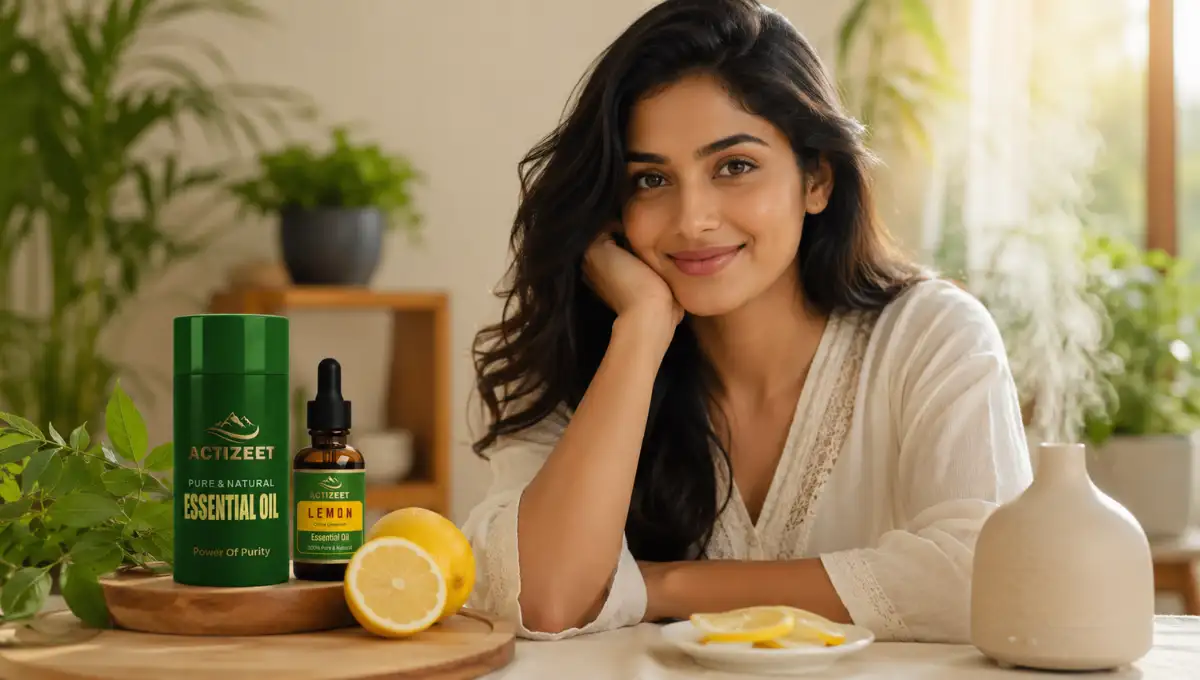
Best Lemon Oil in India 2026: How to Choose Genuine Citrus limon Safely and Why ACTIZEET® Is India's Most Trusted Option
Lemon essential oil is one of India's most purchased aromatics — but it carries a unique safety challenge that most sellers and most buyers are unaware of. Cold-pressed lemon oil contains furanocoumarins that, under India's extreme UV radiation, can cause severe permanent skin burns and hyperpigmentation. This guide cuts through the market confusion, explains exactly what makes lemon oil genuinely therapeutic and genuinely safe for India's climate, and shows why ACTIZEET® stands apart.
The Most Critical Quality Issue: Understanding Phototoxicity in India's Context
No other essential oil category in this guide has a safety issue as significant and as India-specific as lemon oil's phototoxicity risk. Before evaluating limonene percentage, botanical species accuracy, or aromatic quality, every Indian buyer of lemon essential oil must understand the extraction method distinction that determines whether the product is safe for skin use in India's UV environment.
How Phototoxicity Works and Why India's UV Is the Decisive Factor
Phototoxicity occurs when certain chemical compounds in a substance — specifically furanocoumarins including bergapten, psoralen, and xanthotoxin — absorb UV radiation and transfer the energy to skin cells, causing oxidative damage to cellular DNA, proteins, and lipids that produces severe inflammation resembling a chemical burn. This reaction is dose-dependent on both the furanocoumarin concentration on the skin and the UV radiation intensity. The minimum erythemal dose of UV required to trigger a phototoxic reaction with bergapten is dramatically lower than the UV dose Indian skin receives during any outdoor activity at any time of year.
European essential oil safety guidelines establish a bergapten limit of 0.0001% in leave-on skin products — a threshold developed for the UV Index 2 to 4 typical of northern European climates where the guidelines were written. India's UV Index of 8 to 12 year-round means that the UV radiation available for phototoxic reaction is 2 to 6 times higher than in the environments where those safety thresholds were developed. A cold-pressed lemon oil application that might cause mild temporary redness in a UK or German winter could cause severe, potentially permanent hyperpigmentation on Indian skin in Indian summer sun. This is not a marginal difference in risk — it is the difference between a manageable caution and a serious skin safety issue that Indian buyers of lemon oil deserve to understand clearly before purchase.
Cold-Pressed vs Steam-Distilled — The Extraction Method That Changes Everything
| Feature | Cold-Pressed Lemon Oil | Steam-Distilled / FCF Lemon Oil |
|---|---|---|
| Furanocoumarins present? | Yes — bergapten, psoralen, xanthotoxin from the peel wax | No — furanocoumarins are too heavy/non-volatile to be captured by steam distillation |
| Phototoxic in Indian UV? | Yes — severe risk in India's UV Index 8–12 environment | No — safe for topical application without UV avoidance requirement |
| Limonene content | 65–75% (same range as steam-distilled) | 65–75% (same therapeutic compound range) |
| Aromatic character | More complete "whole lemon" peel character — fuller, slightly more complex | Fresher, more purely terpene-citrus — slightly lighter but genuinely pleasant |
| Therapeutic value for skin? | Incomplete — phototoxicity negates safe skin brightening benefit in India | Full — limonene tyrosinase inhibition and antioxidant skin benefits safely accessible |
| Safe for diffusion? | Yes — phototoxicity is a topical/UV-contact issue, not an aromatic inhalation issue | Yes — all diffusion applications safe |
| Safe for household cleaning? | Yes — limonene solvent activity same; skin contact concern noted | Yes — with no skin contact phototoxicity concern |
| Appropriate for Indian users? | Only for diffusion and cleaning — NOT for any topical skin application | Appropriate for all applications including topical when properly diluted |
What Makes a Genuinely Good Lemon Essential Oil Beyond Safety
Once the phototoxicity safety issue is addressed through correct extraction method selection, the remaining quality considerations for lemon oil follow the established patterns of essential oil quality evaluation: species identity, limonene concentration, aromatic authenticity, and production transparency.
Genuine therapeutic lemon essential oil is produced from Citrus limon — the common lemon whose peel yields the highest limonene content and the most authentic citrus-fresh aromatic profile. Other citrus species — lemon verbena, lemongrass, lemon myrtle — are sometimes marketed with "lemon" naming in aromatics and cosmetics but produce very different compound profiles (citral-dominant rather than limonene-dominant) with different aromatic characters and different therapeutic applications. Lemon-scented essential oils from non-Citrus limon sources are not substitutes for genuine lemon essential oil's limonene-mediated dopaminergic, antimicrobial, and metabolic mechanisms.
The limonene content at 65 to 75% in genuine Citrus limon essential oil is the compound quality marker — limonene below 60% suggests incorrect species, incorrect plant part, or poor distillation practice. Limonene above 80% may indicate synthetic limonene addition to boost apparent quality, which would create a chromatographically limonene-rich profile without the complete botanical minor compound matrix (citral, linalool, beta-pinene, gamma-terpinene) that delivers the full therapeutic character.
🍋 ACTIZEET® Lemon Essential Oil: clearly specified extraction method with phototoxicity status disclosed — genuine Citrus limon with limonene at 65 to 75%, citral authenticity, and the complete compound profile for India's safest and most therapeutic lemon oil in 2026.
Shop ACTIZEET® →6 Quality Criteria for the Best Lemon Oil in India
For any lemon oil intended for topical skin use in India, the label must explicitly state either "steam-distilled," "furocoumarin-free (FCF)," or "furanocoumarin-free" — confirming that the extraction method captures the volatile limonene fraction without the heavier phototoxic furanocoumarin compounds. Products labeled simply as "cold-pressed," "expressed," or "expression" are phototoxic and should be restricted to diffusion and cleaning applications in the Indian context.
Products where the extraction method is not disclosed at all should be treated as potentially cold-pressed for safety purposes — the absence of FCF or steam-distilled declaration when these are the relevant safety specifications for an Indian buyer is itself a supplier transparency failure. The best lemon oil in India for 2026 will always specify extraction method because transparent labeling is the foundation of safe use in a UV-rich climate.
The label should clearly state Citrus limon L. as the botanical species — confirming that the oil is genuine lemon essential oil rather than a lemon-scented citrus alternative or a non-citrus "lemon" aromatic. Lemongrass (Cymbopogon citratus) and lemon myrtle (Backhousia citriodora) produce citral-dominant oils with different compound profiles and different therapeutic applications than limonene-dominant genuine lemon oil. Lemon verbena (Aloysia citrodora) is similarly different. Each has its own legitimate applications but none is a substitute for Citrus limon when the limonene-mediated mood, cognitive, and metabolic benefits are what you are seeking.
GC-MS analysis should confirm limonene as the dominant compound at 65 to 75% of total composition, alongside the characteristic Citrus limon supporting compound matrix: citral (geranial plus neral) at 2 to 7% — the sharp citrus-fresh aromatic that gives lemon oil its intensely recognizable character; beta-pinene at 8 to 12%; gamma-terpinene at 5 to 10%; linalool at 1 to 5%; and sabinene at 2 to 8%. This supporting compound fingerprint collectively confirms both species authenticity and appropriate distillation quality. Limonene without the citral-pinene-linalool supporting matrix suggests either synthetic limonene blending or incorrect species.
Genuine Citrus limon essential oil has an intensely bright, sharp, fresh citrus aromatic character that is immediately recognizable as "real lemon" — more intensely and more purely citrus-fresh than the lemon fragrance in household cleaners or synthetic lemon candy. The citral component gives genuine lemon oil a particular sharp, bright freshness that distinguishes it from the softer sweetness of orange oil or the more complex character of bergamot. A lemon oil that smells flat, sweet without the sharp edge, or primarily herbal (which might indicate lemongrass substitution) is not providing the authentic Citrus limon aromatic profile that corresponds to the research-documented limonene and citral compound activity.
Limonene is widely produced synthetically as an industrial solvent and fragrance compound — it is cheap, highly available, and smells essentially identical to the botanical limonene in genuine lemon essential oil. Synthetic limonene blended into a carrier creates a product that smells like lemon oil but has none of the complete botanical minor compound matrix that delivers the full spectrum of lemon oil's therapeutic effects. The purity test for lemon oil: evaporation from paper (genuine undiluted lemon oil evaporates completely without oily stain within 20 to 30 minutes), GC-MS minor compound matrix verification (synthetic limonene creates an abnormally clean single-peak chromatogram without the supporting citral, pinenes, and linalool of genuine botanical distillation), and supplier transparency about botanical source and production.
Limonene undergoes photo-oxidation with UV light, converting to peroxidized limonene derivatives that are both less therapeutically active and more likely to cause skin sensitization than fresh limonene. Dark amber glass with an airtight seal is essential for preserving the limonene compound profile through the product's useful shelf life. Additionally, the best lemon oil in India provides India-specific safe use guidance that addresses the phototoxicity concern explicitly for Indian UV conditions — not just the generic European safety guidelines that were calibrated for a very different UV environment. ACTIZEET® provides exactly this India-context guidance because they understand that generic international essential oil safety guidelines are insufficient for the specific risk context that India's UV Index creates for lemon oil topical use.
Red Flags: What to Avoid When Buying Lemon Oil in India
- No extraction method stated on the label. The single most critical red flag specifically for lemon oil. Without knowing whether the oil is cold-pressed (phototoxic) or steam-distilled/FCF (safe for topical use), a buyer cannot make safe use decisions for India's UV environment. Responsible lemon oil suppliers for the Indian market always disclose extraction method.
- Cold-pressed lemon oil marketed for skin care, face, or hair use without phototoxicity warning. Cold-pressed lemon oil has legitimate applications (diffusion, cleaning, internal food-grade use) but is not appropriate for topical skin use in India without a strict 12 to 18-hour sun-avoidance protocol that is not realistic for the vast majority of Indian daily life. Marketing cold-pressed lemon oil for skin or face use without this specific, prominent India-context phototoxicity warning is irresponsible for an Indian audience.
- "Lemon oil" without Citrus limon species specified. Without the Latin species name, the product could be lemongrass (Cymbopogon citratus), lemon myrtle (Backhousia citriodora), or other lemon-scented botanicals with citral-dominant rather than limonene-dominant compound profiles — different therapeutic applications from genuine Citrus limon.
- Very high limonene content (above 80%) with very clean GC-MS chromatography. Genuine botanical Citrus limon distillate has 65 to 75% limonene with the natural supporting compound matrix. Limonene above 80% with minimal supporting compounds suggests synthetic limonene addition — providing the aroma without the full therapeutic botanical compound profile.
- Absence of citral in GC-MS data. Citral at 2 to 7% is the compound responsible for lemon oil's characteristic intensely sharp-fresh aromatic quality. Genuine Citrus limon steam-distilled or FCF oil contains meaningful citral. Absence of citral may indicate excessive heat during distillation (degrading citral), incorrect species, or synthetic limonene preparation without the botanical compound matrix.
- Products marketed as "lemon essential oil" that smell primarily herbal rather than bright citrus-fresh. If the oil smells primarily of grass, herbs, or a milder, sweeter citrus without the intensely fresh sharp lemon character, the most likely explanation is lemongrass substitution — a citral-dominant oil that smells vaguely lemon-like but has a very different compound profile and different therapeutic applications from genuine Citrus limon.
India Lemon Oil Market 2026: What You Are Choosing Between
| Market Category | C. limon Named | FCF/SD Confirmed | Limonene 65–75% | India Safety Guidance | Topical Use Safety |
|---|---|---|---|---|---|
| Cold-Pressed No Warning Most common market product |
Sometimes | No — phototoxic | Yes — same range | Absent | Unsafe for India UV |
| Lemongrass Mislabeled Cymbopogon sold as lemon oil |
No — wrong species | Non-phototoxic but wrong | No — citral dominant | Partial | Safe but wrong product |
| Mid-Tier FCF Lemon Genuine SD, limited documentation |
Often | Usually — limited documentation | Likely — unconfirmed | Basic | Probably safe — unverified |
| ACTIZEET® Lemon Oil C. limon, FCF confirmed, GC-MS |
Yes — C. limon | Yes — confirmed FCF/SD | Yes — 65–75% verified | Yes — India-specific | Safe when diluted |
Why ACTIZEET® Is the Best Lemon Oil in India in 2026
ACTIZEET® Lemon Essential Oil — Citrus limon Confirmed, FCF/Steam-Distilled Safety Specified, Limonene 65–75% Verified, India's Most Transparently Safe and Therapeutically Complete Nimbu Oil
ACTIZEET® Lemon Essential Oil addresses both the quality and the safety dimensions that the best lemon oil in India must satisfy. Citrus limon botanical species specified — not lemongrass, not lemon myrtle, not an unspecified citrus source. Extraction method and phototoxicity status clearly disclosed, allowing Indian buyers to make informed safe-use decisions for India's UV Index 8 to 12 environment. GC-MS confirming limonene at 65 to 75% with the authentic supporting citral, linalool, and pinene compound matrix. India-specific safe use guidance covering the phototoxicity avoidance protocol and appropriate dilution for all relevant applications. Dark glass UV protection maintaining limonene integrity through the product's full shelf life. The nimbu botanical that every Indian recognizes — in the most safety-aware, most quality-verified, and most honestly labeled essential oil form available in India 2026.
- FCF/steam-distilled extraction confirmed — the safety specification that makes ACTIZEET® appropriate for topical skin use in India's UV environment while most market products are not.
- Citrus limon species specified — eliminating the lemongrass and lemon myrtle substitution that delivers different compound profiles and different therapeutic applications under the same "lemon oil" name.
- Limonene at 65 to 75% verified — the therapeutic compound at documented concentration for the dopaminergic mood, antimicrobial, antioxidant, and metabolic mechanisms that make genuine lemon oil therapeutically valuable.
- Citral at 2 to 7% confirming authentic botanical compound matrix — not synthetic limonene in carrier without the complete Citrus limon aromatic and therapeutic compound profile.
- India-specific safe use guidance — the context-aware safety communication that acknowledges what generic European essential oil safety standards fail to address for Indian UV conditions.
How to Use ACTIZEET® Lemon Oil for Best Results in India
Morning Diffusion (Any Lemon Oil)
3 to 4 drops in a 100 ml diffuser during the morning working or study period. Safe for both cold-pressed and FCF lemon oil — phototoxicity requires skin contact and UV, not inhalation. The dopaminergic mood uplift, cognitive clarity, and anxiety-reducing benefits accumulate with consistent morning diffusion use.
Nighttime Skin Care (FCF Only — Critical)
2 drops FCF ACTIZEET® lemon oil in 1 tablespoon of carrier oil. Apply to face and neck before bed — NEVER during the day or before any sun exposure. Consistent nightly use for 4 to 6 weeks produces the tyrosinase-inhibiting hyperpigmentation reduction that is lemon oil's most requested India skin benefit.
Kitchen Antimicrobial Spray
15 drops in 500 ml warm water with dish soap. Safe for either extraction method when used as surface spray — the limonene degreasing and antimicrobial mechanism against food-borne pathogens makes this the most effective and most pleasant natural kitchen cleaner available. Shake before use.
Nausea Relief (Any Lemon Oil)
2 drops on a tissue or personal inhaler. Hold near nostrils, inhale gently for 30 to 60 seconds. The 5-HT3 antiemetic mechanism operates through olfactory inhalation. Particularly appropriate for pregnancy morning sickness — safe for aromatic inhalation use when topical safety constraints apply to pregnancy.
Scalp Treatment (FCF Only)
5 drops FCF lemon oil in 2 tablespoons of jojoba oil. Massage into scalp before washing. Malassezia antifungal activity and sebum regulation for dandruff and oily scalp. Thorough rinsing essential before any outdoor exposure — even FCF oil residue on scalp with prolonged outdoor activity should be washed before extended sun exposure as precaution.
Digestive Support Diffusion
2 to 3 drops in diffuser during and after meals. The limonene carminative and gastric motility-supporting activity, choleretic bile stimulation for fat digestion, and the phase II liver enzyme induction all operate through the aromatic delivery route — the most practical and most comfortable route for regular digestive support without any topical application requirement.
Pure Citrus limon essential oil. Extraction method clearly stated. Phototoxicity status disclosed for India's UV environment. Limonene at 65 to 75% verified by GC-MS. Citral present confirming authentic botanical compound matrix. India-specific safe use guidance for every application type. Dark glass UV protection. No synthetic limonene addition. No lemongrass substitution. The nimbu botanical that India has always trusted — in the most safety-aware, most quality-verified, and most honestly documented essential oil form available to Indian buyers in 2026.
🍋 Order ACTIZEET® Lemon Essential Oil →Frequently Asked Questions
The Best Lemon Oil in India 2026: Safety First, Then Quality — And ACTIZEET® Delivers Both
The best lemon oil in India in 2026 is the one that is both genuinely therapeutic and genuinely safe for India's specific UV environment. That means FCF or steam-distilled extraction with clear phototoxicity status disclosure — the safety criterion that most lemon oils in India fail to meet by simply not providing this essential information to buyers. It means Citrus limon species specified to confirm genuine limonene-dominant therapeutic identity. It means GC-MS verifying limonene at 65 to 75% with the citral and pinene supporting compound matrix that distinguishes genuine botanical distillate from synthetic limonene preparations. And it means India-specific safe use guidance that acknowledges what generic essential oil safety guidelines calibrated for northern European UV levels do not adequately address for India's UV Index 8 to 12 reality.
ACTIZEET® Lemon Essential Oil meets every criterion. It is the nimbu in its most quality-verified, most safety-conscious, and most honestly documented form — the product that honors both India's deep cultural familiarity with lemon and the therapeutic research that validates lemon oil's genuine, broad, and practically accessible health benefits for Indian users who deserve both the benefit and the safety information in equal measure.
Latest From Our Blog

15 Juniper Berry Essential Oil Benefits: How Juniperus communis Delivers 87+ Active Compounds, PubMed-Confirmed Antimicrobial Power, and Forest-Deep Detoxifying Therapy
Discover 15 juniper berry essential oil benefits including PubMed antimicrobial...

Best Nutmeg Oil in India 2026: A Complete Buyer’s Guide to Pure, Authentic Myristica fragrans Essential Oil
Looking for the best nutmeg oil in India in 2026?...

Best Geranium Oil in India 2026: A Complete Buyer’s Guide to Pure, Authentic Pelargonium graveolens Essential Oil
Looking for the best geranium oil in India in 2026?...

Best Aniseed Oil in India 2026: How to Find Genuine Pimpinella anisum and Why ACTIZEET® Delivers the Authentic Saunf Botanical at Its Most Therapeutic
Looking for the best aniseed oil in India? Learn how...