
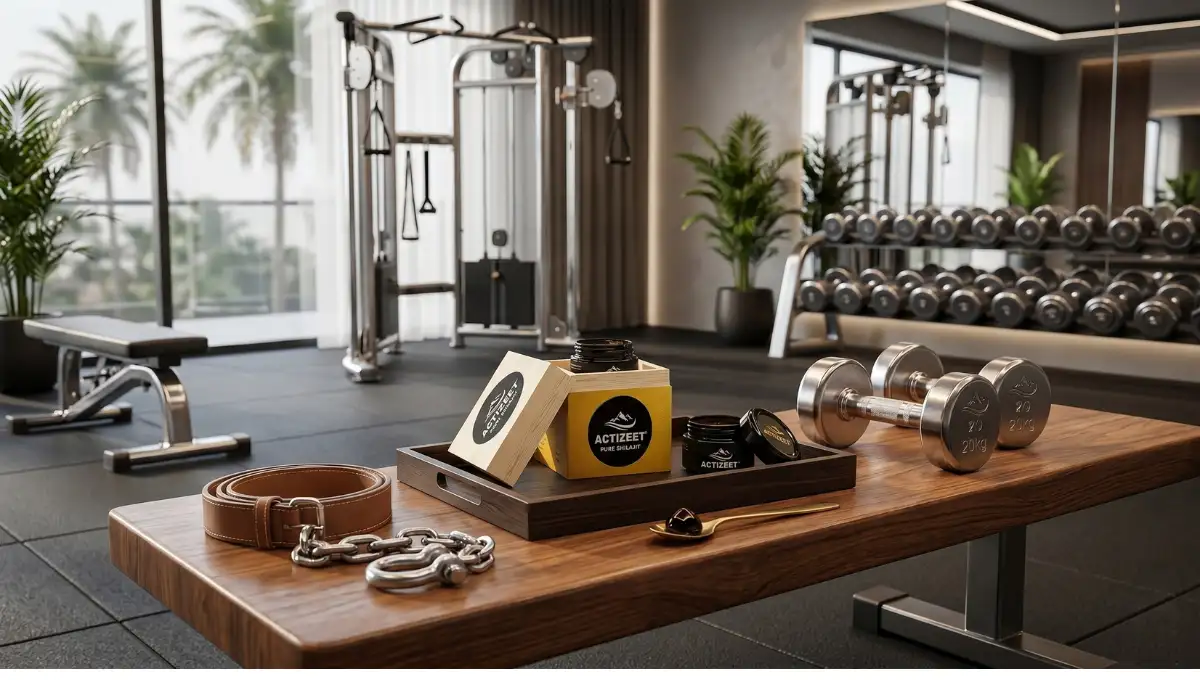
If you train hard and expect real results, you already know that what happens outside the gym matters just as much as what happens inside it. Testosterone, recovery, and energy production are the invisible levers that determine how fast you grow. Shilajit, a mineral-dense resin from high-altitude Himalayan rock, has been used in Ayurvedic practice for over 3,000 years to support exactly these three pillars. Now clinical research is beginning to confirm what traditional practitioners have always known.
What Is Shilajit and Why Do Bodybuilders Care About It?
Shilajit is a thick, tar-like substance that seeps from cracks in mountain rock across the Himalayas, Altai, and other high-altitude ranges. It forms over millions of years through the slow decomposition of plant matter, compressed by geological pressure and enriched with minerals from the surrounding rock. The result is one of the most mineral-dense, bioavailable natural substances on Earth.
The primary active compound in Shilajit is fulvic acid, a small organic molecule that helps carry nutrients directly into cells. Alongside fulvic acid, you get humic acid, dibenzo-alpha-pyrones, over 84 trace minerals, and various plant metabolites. For bodybuilders, what matters most is how these compounds interact with testosterone production, cellular energy, muscle repair, and training endurance.
This is not a stimulant. Shilajit does not give you a caffeine spike. What it does is work at the cellular level to support the biological conditions that allow your body to build muscle and recover from training more effectively. That distinction matters.
The Testosterone Connection: What the Studies Actually Show
Testosterone is the most important anabolic hormone for muscle growth. When levels are optimal, protein synthesis improves, fat oxidation increases, recovery speeds up, and your drive to train stays strong. When levels drop, everything suffers.
One of the most cited studies on Shilajit and testosterone is a randomized, double-blind, placebo-controlled clinical trial published in the journal Andrologia. Researchers found that healthy men between the ages of 45 and 55 who supplemented with 500 mg of purified Shilajit daily for 90 days saw meaningful increases in total testosterone, free testosterone, and DHEA levels, compared to those receiving a placebo. These are not minor statistical fluctuations. Free testosterone rose by over 19% and DHEA by more than 31%.
For natural athletes who are not using pharmaceutical interventions, a consistent, clinically demonstrated increase of that magnitude is significant. It means more of the hormone that drives muscle protein synthesis is circulating and available to your muscle tissue when you need it most.
Shilajit and Muscle Recovery: Protecting What You Build
Building muscle requires breaking it down first. Every hard training session creates microscopic damage in muscle fibers. Your body then repairs that damage, and the repaired tissue is slightly denser and stronger than before. That is the fundamental mechanism of hypertrophy. But if the recovery side of that equation is slow or incomplete, progress stalls.
A study published on PubMed Central examined the effects of 8 weeks of Shilajit supplementation in active adults and found that participants in the Shilajit group experienced significantly less decline in muscular strength after a fatiguing exercise protocol compared to those in the placebo group. The Shilajit group saw roughly an 8.9% drop in strength, while the placebo group dropped by 16 to 17%. That is close to half the strength loss, which in practical terms means you carry more of your peak capacity into the next session.
The same study tracked hydroxyproline, a biological marker of collagen breakdown. Lower hydroxyproline in the Shilajit group indicated that connective tissue, including tendons, ligaments, and the collagen structures around muscle fibers, was being broken down at a much slower rate. For heavy lifters, this is arguably as important as the testosterone data. Connective tissue injuries are one of the primary reasons experienced lifters lose training time.
Why connective tissue matters to bodybuilders: Tendons and ligaments do not repair as quickly as muscle. Protecting them through consistent training blocks is the difference between a 10-year lifting career and one that ends prematurely with a torn rotator cuff or patellar tendon. Shilajit's apparent ability to reduce collagen breakdown markers during intense training is a property worth paying attention to.
ATP Production and Energy: Why Shilajit Changes How You Feel in the Gym
Adenosine triphosphate, or ATP, is the currency your cells use to power every contraction, every lift, every step. The more efficiently your mitochondria produce ATP, the more sustained energy your muscles have during training. When mitochondrial function declines, fatigue comes earlier, intensity drops, and performance suffers.
Fulvic acid, the primary active compound in Shilajit, supports mitochondrial function by improving the efficiency of the electron transport chain inside cells. Animal studies have demonstrated that Shilajit supplementation increases ATP availability, and human studies have reported reduced fatigue and improved endurance as downstream effects of this process.
For bodybuilders, this translates practically. Better ATP availability means you can push harder in later sets. You can complete your volume with less perceived effort. You recover between sets more quickly. None of these effects are dramatic in isolation, but accumulated across months of consistent training, the difference in total training volume is meaningful.
This is also why Shilajit is sometimes described as an adaptogen, a substance that helps the body manage physical stress more efficiently without forcing an acute stimulant response.
Premium Grade · Lab Tested · Directly from the Himalayas
Muscle Gene Expression: The Science Few People Are Talking About
One of the most compelling findings in recent Shilajit research came from a study examining skeletal muscle gene expression after supplementation. The researchers found that Shilajit significantly upregulated genes related to the extracellular matrix in skeletal muscle. These genes govern how muscles adapt to mechanical load, how elastic muscle tissue is, how quickly it repairs after damage, and how effectively it regenerates following stress.
The genes that were upregulated included those that code for multiple types of collagen, as well as other structural proteins essential for muscle architecture. What made this study notable is that it was the first to demonstrate that an oral natural supplement could produce skeletal muscle adaptation at the gene expression level. This is not simply a supplement that masks fatigue or boosts a hormone temporarily. It appears to shift the biological environment inside muscle tissue toward one that is more conducive to growth and repair.
For bodybuilders focused on long-term progress rather than short-term performance spikes, this kind of foundational adaptation is exactly what a quality supplement should be doing.
Shilajit vs. Common Bodybuilding Supplements: Where Does It Fit?
Shilajit is not a replacement for creatine, protein, or a well-structured diet. Think of it as a foundational supplement that improves the conditions under which everything else works better. When your testosterone levels are supported, creatine-driven strength gains build on a stronger hormonal base. When your mitochondria are functioning more efficiently, your protein synthesis machinery runs on better fuel. When your connective tissue is protected, you stay healthy enough to train consistently over months and years.
The most accurate category for Shilajit in a bodybuilding stack is a natural anabolic support supplement. It is not stimulant-based, not hormonal in the pharmaceutical sense, and not dependent on cycling. You can use it year-round as part of a complete approach to natural performance enhancement.
Who Benefits Most from Shilajit for Bodybuilding?
Men over 30 who are experiencing the natural decline in testosterone that comes with aging will likely notice the most pronounced effects. As testosterone drops by roughly 1% per year after the age of 30, even a consistent 15 to 20% improvement from a natural supplement represents a meaningful reversal of that trend.
Lifters who train at high volumes and frequently battle fatigue or slow recovery will also benefit from the ATP-support and connective tissue protection that Shilajit provides. And athletes who have historically dealt with tendon or joint issues may find that the reduction in collagen breakdown markers helps keep training consistent.
Beginners can use it, but the effects will likely be more noticeable in intermediate to advanced trainees who are already pushing their recovery capacity to its limits.
Choosing a Quality Shilajit Product: What to Look For
Product quality is the biggest variable in Shilajit supplementation. Raw, unprocessed Shilajit can contain heavy metals, mycotoxins, and other contaminants from the rocks and environment it is harvested from. For a supplement to deliver the benefits documented in clinical research, it must be purified properly and standardized to ensure consistent levels of fulvic acid and active compounds.
Here is what to evaluate before buying any Shilajit product:
Purification method: The Shilajit used in the strongest clinical trials was purified before use. Cold-water purification or triple-purification methods preserve the active compounds while removing heavy metals and other contaminants.
Fulvic acid content: A quality Shilajit resin should contain at least 60 to 70% fulvic acid. Products that do not disclose this figure often have much lower concentrations, which means reduced bioavailability and weaker effects.
Form: Resin is the most bioavailable form of Shilajit because it most closely resembles the natural substance. Powders and capsules involve processing that can degrade the active compounds. If you are serious about results, choose a high-grade resin.
Third-party testing: Independent lab testing for heavy metals and contaminants is non-negotiable. Look for brands that publish their certificates of analysis openly.
Altitude of harvest: Shilajit from higher altitudes in the Himalayas, typically above 16,000 feet, is generally considered superior in mineral density and fulvic acid concentration.
ACTIZEET® Himalayan Shilajit Resin is sourced from high-altitude Himalayan rocks, purified using a rigorous triple-purification process, and independently tested for safety and potency. It is one of the most trusted Shilajit brands in India, used by athletes and fitness enthusiasts who want a product they can count on.
Shop ACTIZEET® Shilajit Resin NowHow to Use Shilajit for Bodybuilding: Dosage and Timing
The dose used in the most referenced clinical trials is 500 mg per day, split into two servings of 250 mg each. For a resin product, 500 mg is roughly the size of a small pea. Many experienced users dissolve their dose in warm water or warm milk to improve absorption.
Consistency matters far more than timing. Shilajit's benefits accumulate over weeks and months of regular use. Unlike a pre-workout that has an acute effect, Shilajit works by gradually improving the biological conditions that support muscle growth and recovery. Most users report noticeable differences in energy, recovery, and training quality after 4 to 8 weeks of daily supplementation.
There is no strong evidence that cycling Shilajit is necessary. Because it works through nutritional and adaptogenic mechanisms rather than receptor downregulation, it does not appear to produce tolerance in the way some compounds do. That said, taking periodic breaks of 2 to 4 weeks is a reasonable approach to ensure long-term sensitivity.
Avoid taking Shilajit with cold water or chlorinated tap water. The active compounds, particularly fulvic acid, are sensitive to temperature and can be partially denatured in very cold conditions. Warm or room-temperature water is the standard recommendation.
Safety Profile: Is Shilajit Safe for Athletes?
The safety data on Shilajit is generally reassuring. Multiple clinical trials at doses up to 500 mg per day have not reported significant adverse effects in healthy adults. Shilajit has been used continuously in Ayurvedic medicine for thousands of years, and modern toxicological studies have supported its safety profile when the product is properly purified.
The key caveat is product quality. Unpurified or low-quality Shilajit products have been associated with elevated heavy metal levels, particularly lead and arsenic. This is why purification and third-party testing are not optional considerations when choosing a product.
Men with hormone-sensitive conditions should consult a healthcare provider before using Shilajit, given its demonstrated effects on testosterone and DHEA. Athletes subject to anti-doping regulations should also verify that their specific product is tested for prohibited substances, as natural supplements can occasionally be contaminated.
The Bigger Picture: Building a Natural Performance Foundation
Bodybuilding at the highest level, whether competitive or personal, is a long game. Supplements that offer shortcuts through hormonal manipulation or central nervous system overstimulation often extract a physiological cost that catches up with you over time. The athletes who build the most durable physiques are usually the ones who have maintained consistent training, strong recovery, and smart nutritional support for years.
Shilajit fits that philosophy. It supports testosterone naturally rather than replacing it. It improves cellular energy production through established biological pathways. It protects connective tissue from the cumulative stress of heavy training. And it does this without requiring post-cycle recovery, without stimulant dependence, and without the risk of hormonal suppression that comes with pharmaceutical interventions.
For the serious natural athlete, that combination is worth a great deal.
Frequently Asked Questions About Shilajit for Bodybuilding
Can Shilajit replace testosterone therapy?
No. Shilajit can support healthy testosterone production within a normal physiological range, but it is not a medical treatment for clinically diagnosed testosterone deficiency. If you have been diagnosed with hypogonadism or another condition affecting hormone production, speak to a qualified physician rather than self-treating with supplements.
How long before I notice results from Shilajit?
Most users report noticeable improvements in energy and recovery within 3 to 6 weeks of consistent daily use. Hormonal changes, as documented in clinical trials, appear to be most measurable after 8 to 12 weeks of continuous supplementation.
Can I stack Shilajit with creatine or protein supplements?
Yes. Shilajit works through different mechanisms than creatine or protein and there is no known negative interaction between them. Many athletes stack all three as part of a comprehensive natural performance protocol.
Is Shilajit resin better than Shilajit capsules?
Resin is generally considered the superior form because it is minimally processed and preserves the natural profile of active compounds. Capsules can be convenient, but the encapsulation process often involves heat or drying that can reduce fulvic acid potency. For maximum benefit, a high-quality purified resin is the preferred choice.
Does Shilajit help with fat loss?
Indirectly, yes. Higher testosterone levels support greater lean mass retention and improved fat oxidation. Better mitochondrial efficiency also means your cells burn fuel more effectively. Neither effect is dramatic on its own, but as part of a well-structured training and nutrition program, the hormonal and metabolic support Shilajit provides can contribute to body composition improvements over time.
Sourced from high-altitude Himalayas · Rigorously purified · Trusted by athletes across India
Latest From Our Blog

Shilajit for Gym: How Himalayan Resin Builds Strength, Boosts Endurance, Accelerates Recovery, and Optimizes Testosterone for Indian Athletes and Gym-Goers
Discover how shilajit for gym workouts boosts strength, endurance, testosterone,...

How to Restore Energy and Stamina by using Shilajit
Discover the ancient secret to restoring energy and stamina naturally....

Shilajit for Sexual Health Problems: What the Research Really Says and What Actually Works
Discover how Shilajit helps sexual health problems like low libido,...

Shilajit for PCOS: A Practical, Evidence-Based Guide to Using This Ancient Resin for Hormonal Balance
Discover how Shilajit for PCOS can help regulate hormones, manage...