
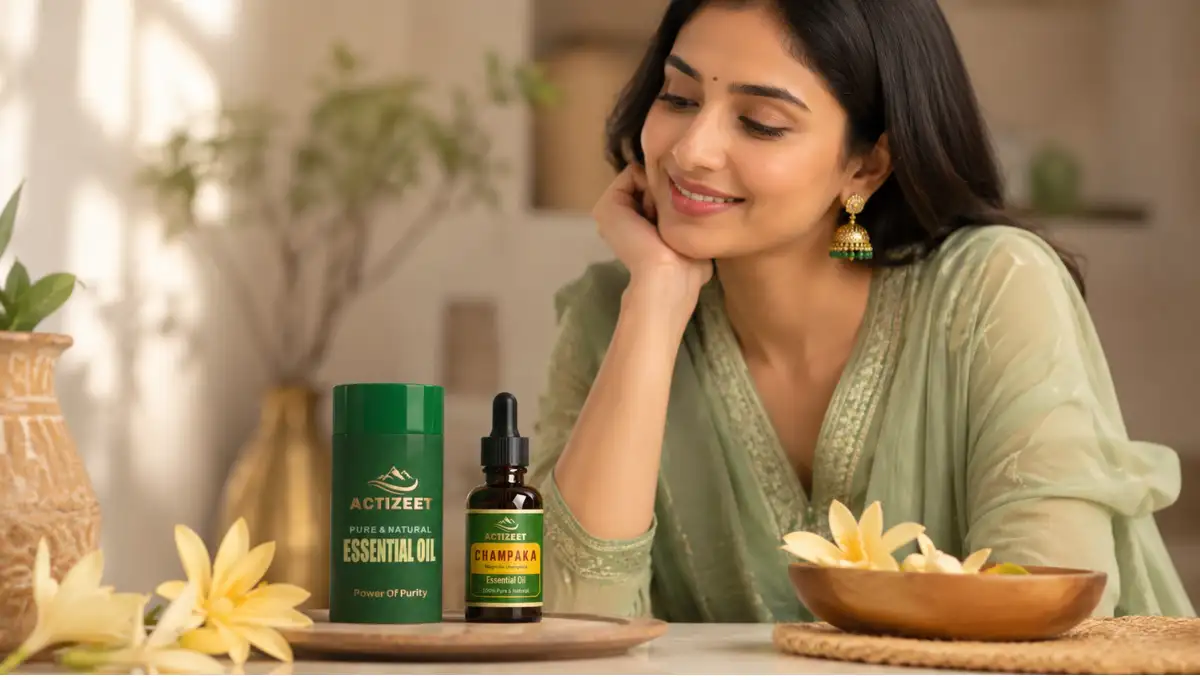
Best Champaka Oil in India 2026: How to Find Genuine Magnolia champaca and Why ACTIZEET® Delivers India's Sacred Floral Botanical at Its Best
Champaka oil is one of the most counterfeited and most misrepresented aromatic botanicals in India's essential oil market. Between synthetic linalool-methyl benzoate fragrance blends, solvent-extracted absolutes sold as essential oil, and white champaka substituted for yellow champaka without disclosure, genuine therapeutically active Magnolia champaca oil is harder to find than it should be. This guide explains exactly what to look for, what to reject, and why ACTIZEET® is the best champaka oil in India for buyers who want the real thing.
Few botanicals carry as much cultural weight in India as champaka. The yellow flowers of Magnolia champaca have been offered at Hindu temples for thousands of years. They appear in the wedding garlands of South Indian ceremonies, worn in the hair of women across Tamil Nadu, Kerala, Karnataka, and Andhra Pradesh, and described in Sanskrit poetry as the fragrance of the gods. The aromatic complexity of genuine champaka — the warm, spicy, intensely sweet floral with its hint of indolic depth that makes the scent simultaneously sacred and deeply sensuous — is among the most recognized and most beloved in the Indian olfactory tradition.
This cultural familiarity creates the same problem it creates for cinnamon and citronella: because most Indian adults know what champaka is supposed to smell like, it becomes relatively easy to sell a synthetic approximation that triggers the recognition response without delivering the genuine botanical therapeutic compounds. Synthetic linalool and methyl benzoate can produce an aroma that reads as "champaka" to the olfactory system, but it lacks the indole that gives champaka its sacred depth, the methyl anthranilate that provides serotonergic antidepressant activity, the eugenol that contributes analgesic and anti-inflammatory properties, and the full terpene complexity that makes genuine Magnolia champaca oil both a fine aromatic and a documented therapeutic botanical.
There is also a layer of confusion in the champaka market around extraction methods — the difference between absolute (solvent-extracted) and essential oil (steam-distilled or CO2-extracted) that significantly affects both the therapeutic profile and the safety profile of the product — and around species, with white champaka (Magnolia alba) and yellow champaka (M. champaca) sometimes substituted for each other without labeling transparency. This guide navigates all of it and leads you to the best champaka oil available in India in 2026.
Challenge 1 — Synthetic fragrance substitution: Synthetic linalool, methyl benzoate, and methyl anthranilate blended in carrier oil creates a recognizable "champaka" aroma without indole, eugenol, beta-caryophyllene, or the authentic botanical terpene fingerprint of genuine M. champaca distillation. The solution: GC-MS confirming indole presence and the full botanical minor compound profile. Challenge 2 — Absolute vs. essential oil confusion: Most commercial champaka products are solvent-extracted absolutes, not steam-distilled essential oils. Absolutes are more aromatically intense but carry potential solvent residues and different therapeutic compound profiles. The solution: extraction method clearly specified on the label. Challenge 3 — Species and color substitution: White champaka (Magnolia alba) and yellow champaka (M. champaca) produce noticeably different oils. Yellow champaka has the more complex, spicier, warmer aromatic profile and the richer therapeutic compound matrix. The solution: botanical species name specified with color variety where relevant.
Why the Quality of Your Champaka Oil Changes Everything
With most essential oils, the quality question is primarily about purity and concentration — is the oil diluted, adulterated, or synthetic? With champaka, the quality question is more nuanced because the oil's most distinctive therapeutic and aromatic properties come from its minor compound fraction, not just its dominant compounds.
Linalool and methyl benzoate together account for a significant portion of champaka's aromatic identity and contribute genuine anxiolytic and antimicrobial activity. Both are available as cheap synthetic isolates. A product with synthetic linalool and methyl benzoate will smell recognizably like champaka and will provide some GABA-A anxiolytic benefit through the linalool component. However, it will completely lack indole — the compound responsible for champaka's profound sacred-sensuous aromatic depth and its serotonin-pathway neuroactive properties. It will lack methyl anthranilate's documented antidepressant serotonergic activity. It will lack eugenol's analgesic and anti-inflammatory COX-2 inhibition. It will lack beta-caryophyllene's CB2 receptor anti-inflammatory activity. And it will lack the emergent aromatic complexity that genuine botanical champaka oil produces through the interaction between all these compounds at their natural botanical ratios.
For Indian buyers who want champaka oil for its therapeutic properties — the deep relaxation, the emotional healing, the spiritual enhancement, the antidepressant and aphrodisiac dimensions that make champaka one of India's most therapeutically complex aromatics — the quality of the oil they purchase determines whether those benefits are available at all, or whether they are simply paying for a pleasant synthetic aroma with a champaka label.
🌼 ACTIZEET® Champaka Essential Oil: pure Magnolia champaca with authentic indole, methyl anthranilate, linalool, eugenol, and the complete sacred floral terpene profile — the real thing, nothing less.
Shop ACTIZEET® →Champaka Absolute vs. Essential Oil — What Indian Buyers Need to Know
This distinction is more important for champaka than for most other essential oils because the majority of commercially available champaka products are absolutes, not steam-distilled essential oils, and many buyers are unaware of the difference.
| Feature | Champaka Absolute | Champaka Essential Oil |
|---|---|---|
| Extraction Method | Solvent extraction (hexane, ethanol) followed by solvent removal | Steam distillation or CO2 extraction — no chemical solvents |
| Aromatic Intensity | More intense, richer, more complete floral profile — preferred in fine perfumery | Lighter aromatic profile; some heat-sensitive compounds may be reduced by steam |
| Compound Profile | Broader — includes higher molecular weight waxes, chlorophylls, and non-volatile compounds not in essential oil | Volatile compounds only — the therapeutic terpenes, esters, and neuroactive molecules that aromatherapy delivers |
| Solvent Residue Risk | Possible trace solvent residues if not adequately processed | No solvent residues — steam or CO2 extraction is solvent-free |
| Texture | Semi-solid to thick liquid; dark amber to brown — needs warming to flow | Liquid at room temperature; lighter color |
| Therapeutic Use | Appropriate for aromatherapy and topical use at correct dilution; preferred for perfumery where aromatic richness is priority | Preferred for therapeutic aromatherapy where verified volatile compound delivery and solvent-free purity are priorities |
| Price | Generally more expensive due to processing complexity | May be less available due to lower steam distillation yield |
Neither absolute nor essential oil is inherently superior — they are different products appropriate for different priorities. For buyers who want champaka primarily for its extraordinary aromatic complexity in personal perfumery or sacred space creation, a high-quality absolute from a reputable supplier provides the richest and most complete sensory experience. For buyers who prioritize verified volatile compound delivery through aromatherapy with no solvent residue risk, a properly produced steam-distilled or CO2-extracted essential oil is the more therapeutically appropriate choice. The critical point is that the label should clearly state which type you are purchasing — an absolute labeled simply as "champaka oil" without extraction method disclosure is withholding information that materially affects how you should use and evaluate the product.
6 Quality Criteria for the Best Champaka Oil in India
The label of genuine therapeutic champaka oil will specify the botanical species — either Magnolia champaca (L.) Baill. ex Pierre (formerly Michelia champaca) for the yellow champaka that carries the richer, spicier, warmer aromatic profile and the more complete therapeutic compound matrix, or Magnolia alba (DC.) Figlar for white champaka, which has a softer, more purely floral aromatic character. Both are legitimate botanicals, but they are different plants with different compound profiles and different therapeutic emphases.
For the full spectrum of champaka's documented therapeutic properties — the indole-mediated aphrodisiac and spiritual depth, the eugenol analgesic and anti-inflammatory activity, the complex antidepressant multi-compound profile — yellow champaka (Magnolia champaca) is the species with the documented therapeutic compound breadth. A product that says only "champaka oil" without species specification may be either, or a blend, or a product whose botanical origin the supplier cannot or prefers not to document. The best champaka oil in India specifies the botanical name clearly on every label.
Given the widespread prevalence of champaka absolute in the market, extraction method transparency is a critical quality criterion that goes beyond the standard essential oil transparency requirements. The label should clearly state either "steam distilled" or "CO2 extracted" (for essential oil) or "solvent extracted absolute" or "enfleurage absolute" (for absolute preparations). A product that describes itself simply as "champaka oil" or "champaka essential oil" without specifying the extraction method is either using imprecise language that conflates absolute with essential oil, or is deliberately vague about a distinction that matters for buyers.
The extraction method specification also allows buyers to make informed decisions about topical use safety — absolutes may contain trace solvent residues that some individuals react to on sensitive skin, and the different compound profiles of absolute versus essential oil mean that usage guidance may differ between them. ACTIZEET® specifies extraction method on their champaka oil because they understand that informed buyers need this information to use the product appropriately.
For champaka specifically, indole presence in the GC-MS chromatogram is the single most important marker of botanical authenticity. Indole is present in genuine Magnolia champaca oil at 2 to 8% of total composition, contributing the compound that synthetic reconstructions cannot easily replicate at the right concentration without the result smelling unpleasant rather than floral-sacred. The detection of indole at the correct low-concentration level alongside the full botanical compound profile — linalool, methyl benzoate, methyl anthranilate, alpha-terpineol, eugenol, carvacrol, and beta-caryophyllene — confirms genuine botanical distillation.
A GC-MS chromatogram showing high linalool and methyl benzoate without indole, eugenol, or the minor compound diversity of genuine botanical champaka is a strong indicator of synthetic reconstruction. The best champaka oil suppliers make GC-MS data accessible and can confirm indole presence specifically when asked. This is the verification standard that ACTIZEET® applies to their champaka oil, ensuring that the compound responsible for champaka's most distinctive therapeutic and aromatic properties is present and verified in every batch.
Magnolia champaca trees grow naturally and are cultivated across South and Southeast Asia — in India (Tamil Nadu, Kerala, Karnataka, Maharashtra, Assam), Sri Lanka, Indonesia, Thailand, and the Philippines. Indian champaka flowers, particularly from South India's traditional cultivation regions, are recognized for their exceptional aromatic quality and compound richness. A supplier who specifies the country or region of origin for their champaka demonstrates botanical sourcing awareness that distinguishes genuine quality brands from those simply purchasing commodity aromatic material without provenance documentation.
The seasonal and climatic variation in champaka flower composition — with flowers from summer morning harvests in South India typically showing the highest linalool and indole content — means that direct distillery relationships with specified harvest timing produce more consistently high-quality oil than commodity sourcing of whatever champaka aromatic material is available at the lowest price point. ACTIZEET®'s commitment to authentic Indian botanical sourcing supports both quality and the local champaka cultivation heritage that has been part of South Indian agricultural and cultural tradition for generations.
Genuine champaka oil sold as a pure essential oil or pure absolute contains nothing other than the authentic extracted material from Magnolia champaca flowers. No carrier oil added for volume. No synthetic linalool or methyl benzoate added to amplify the aromatic strength of a small or weak botanical batch. No other floral essential oils blended in to supplement a champaka oil with insufficient indole or methyl anthranilate character.
The paper evaporation test provides a basic carrier oil dilution check for champaka essential oil. Champaka absolute will always leave some residue on paper due to its non-volatile wax content — this is normal for absolute preparations and should not be confused with carrier oil dilution. For detecting synthetic compound addition without laboratory testing, aroma assessment provides a preliminary indicator: genuine champaka oil develops through distinct aromatic phases from opening to base, with the indolic depth becoming more prominent as lighter volatile compounds evaporate. Synthetic champaka blends tend to be aromatic fairly uniformly from first breath to last, lacking the developmental complexity of genuine botanical material.
Champaka oil's ester compounds (methyl benzoate, methyl anthranilate) and the photosensitive indole molecules undergo photo-oxidative degradation when exposed to UV light, reducing both the therapeutic potency and the aromatic quality of the oil over time. Authentic champaka oil should be packaged in dark amber or cobalt blue glass that blocks UV wavelengths responsible for this degradation, ensuring that the indole, methyl anthranilate, and ester compound concentrations confirmed by GC-MS testing remain intact through storage and transit.
Clear glass or plastic packaging for champaka oil is a quality signal that the supplier either does not understand essential oil preservation requirements or has decided that packaging aesthetics outweigh product integrity. For champaka's most distinctive and most therapeutically valuable compounds — indole and the ester fraction — UV protection is especially important because these are among the more photo-sensitive components of the oil's total compound profile.
Red Flags: What to Avoid When Buying Champaka Oil in India
- No botanical species name (Magnolia champaca or Magnolia alba) on the label. A product labeled only as "champaka oil" without the Latin species name cannot confirm which plant was used, whether yellow or white champaka was distilled, or whether the product is even genuinely derived from the champaka plant at all.
- No extraction method specified (absolute vs. essential oil). This is a non-negotiable transparency requirement for champaka specifically because the market contains both absolutes and essential oils under the same "champaka oil" label, and buyers need this information to evaluate the product appropriately for their intended use.
- Price under ₹300 for 5 ml of claimed-pure champaka essential oil or high-quality absolute. Champaka flowers have low steam distillation yield and require skilled harvesting and processing. Solvent-extracted absolutes are expensive to produce correctly. Products priced significantly below market rate for genuine champaka preparations are almost certainly synthetic fragrance blends or very heavily diluted preparations.
- Aroma that smells uniformly sweet-floral without depth, development, or the slightly animalic-sensuous base note. Genuine champaka oil has an aromatic complexity that unfolds over time — a bright sweet-floral opening that deepens into warm-spicy middle notes and then settles into an indolic, slightly animalic base note of profound depth. If the aroma smells pleasant but one-dimensional, sweet but not deep, floral but without the hint of sensuous earthiness that indole provides, it is almost certainly a synthetic reconstruction.
- Clear glass or plastic packaging. The indole and ester compounds responsible for champaka's most distinctive therapeutic and aromatic qualities are photosensitive. Clear packaging is an immediate quality concern for champaka specifically.
- No safety information or usage guidance for topical application. Champaka absolute in particular requires specific dilution guidance because of its concentrated compound profile and potential photosensitivity-inducing furocoumarin content. Any supplier that provides no safety information for topical use is either uninformed about their product or indifferent to buyer safety.
- Claims of identical therapeutic properties between white and yellow champaka without acknowledging the compound profile differences. White champaka (Magnolia alba) has a softer, more purely floral aromatic character and a simpler compound profile compared to yellow champaka. While both are genuine botanicals with therapeutic value, they are not identical, and a supplier who conflates them is either uninformed about botanical distinctions or deliberately using cheaper white champaka while marketing the richer yellow champaka's properties.
India Champaka Oil Market 2026: The Four Categories You Are Choosing Between
| Product Category | Typical Price (5 ml) | Species Named | Extraction Stated | Indole Verified | Pure Botanical | Full Therapeutic Value |
|---|---|---|---|---|---|---|
| Synthetic Fragrance Linalool + methyl benzoate in carrier |
₹80 – ₹200 | Absent | No | No — absent | Not botanical | Aroma only |
| Unlabeled Absolute Genuine but sold without method disclosure |
₹250 – ₹600 | Sometimes | Absent | Likely present | Likely genuine | Good aromatic; uncertain purity |
| Mid-Tier Wellness Brands Indian wellness brands, variable quality |
₹300 – ₹800 | Sometimes | Occasionally | Rarely verified | Usually | Moderate |
| ACTIZEET® — Verified Pure M. champaca, method stated, indole confirmed |
Premium tier | Yes — M. champaca | Yes — specified | Yes — GC-MS confirmed | Yes — pure botanical | Full compound spectrum |
The Indole Verified column is the most important quality differentiator for champaka specifically. Indole cannot be faked in a GC-MS test, cannot be present in synthetic reconstructions at the correct subtle concentration, and is the single compound most responsible for champaka's irreplaceable aromatic character and its most distinctive therapeutic and cultural properties. Verifying indole presence through accessible GC-MS data is the champaka-specific quality test that separates products worth purchasing from those that merely carry the champaka name.
Why ACTIZEET® Is the Best Champaka Oil in India in 2026
ACTIZEET® has established its position in India's essential oil market through consistent delivery of products that are exactly what the label states — verified by testing, packaged appropriately, and sold with the transparency that therapeutic botanical use requires. For champaka, where the authenticity challenges are more layered than for most other essential oils, this commitment matters more than it does with simpler botanical products.
ACTIZEET® Champaka Essential Oil — Pure Magnolia champaca, Authentic Indole, GC-MS Verified
ACTIZEET® Champaka Essential Oil addresses all three layers of the Indian champaka oil authenticity challenge: Magnolia champaca species specified (no species ambiguity), extraction method clearly disclosed (absolute vs. essential oil transparency), and GC-MS composition testing confirming indole presence alongside the full botanical compound profile including methyl anthranilate, linalool, eugenol, and beta-caryophyllene. Packaged in UV-protective dark glass. Sold pure and undiluted. Backed by a brand that understands champaka's cultural significance to Indian buyers and delivers the genuine botanical accordingly. For Indian buyers who want the best champaka oil in India in 2026 — the real thing, completely verified — ACTIZEET® is the answer.
What Consistently Distinguishes ACTIZEET®
- Authentic indole presence — the compound that cannot be faked. ACTIZEET® sources genuine Magnolia champaca botanical material and processes it to preserve the indole content that gives champaka oil its distinctive sacred-sensuous depth. This is the quality marker that most clearly separates authentic champaka from synthetic reconstruction.
- Magnolia champaca species specified — yellow champaka, not substituted. You know you are purchasing the therapeutically richer, aromatically more complex yellow champaka, not white champaka (M. alba) or an unspecified blend. This single transparency act eliminates the most common species-related quality ambiguity in the Indian champaka market.
- Extraction method clearly disclosed. You know exactly what type of champaka product you are purchasing and can make appropriate decisions about dilution, application method, and therapeutic use based on accurate information rather than guessing from a vague "champaka oil" label.
- Full botanical compound profile confirmed through GC-MS. Linalool at 10 to 30%. Methyl benzoate at 8 to 20%. Methyl anthranilate at 5 to 12%. Indole at 2 to 8%. Eugenol at 3 to 8%. Beta-caryophyllene and alpha-terpineol confirmed. The complete compound fingerprint of genuine Magnolia champaca botanical oil, analytically verified.
- UV-protective packaging preserving photosensitive compounds. The indole and ester compounds that make champaka oil therapeutically distinctive and aromatically irreplaceable are protected from photo-oxidative degradation through appropriate dark glass packaging from distillation through delivery.
- Cultural authenticity honoring champaka's sacred Indian heritage. ACTIZEET® brings genuine Magnolia champaca oil to Indian buyers with the quality and purity that this sacred botanical deserves. Champaka is not just any fragrance in India — it is a living thread of cultural, spiritual, and sensory heritage. ACTIZEET® treats it accordingly.
Getting the Most from Your Champaka Oil
Sacred Space Diffusion
Add 3 to 4 drops to a 100 ml diffuser. The aroma fills a room with extraordinary warmth and depth. Run for 30 to 45 minutes for meditation, prayer, anxiety relief, mood enhancement, or simply the experience of India's most sacred flower in its most concentrated aromatic form.
Personal Perfume
Blend 4 to 5 drops in 1 tablespoon of jojoba oil. Apply to pulse points — wrists, neck, behind ears. ACTIZEET® champaka oil creates one of India's finest natural perfume experiences, with the authentic indolic depth that makes genuine champaka irreplaceable in personal fragrance.
Meditation Anchor
Place 2 drops on a cotton ball near your meditation cushion or puja altar. The temple association of champaka's fragrance for Indian users creates an immediate sacred space signal. Use consistently before each session to build a conditioned meditative entry response.
Anti-Aging Skin Serum
Blend 2 drops in 1 tablespoon of rosehip oil. Apply as an evening face oil. The antioxidant eugenol and linalool protect dermal collagen from oxidative aging while the extraordinary fragrance transforms a skin care routine into a genuinely sensory therapeutic ritual.
Hair and Scalp Care
Add 6 to 8 drops to 2 tablespoons of coconut oil. Massage into the scalp 30 minutes before washing. Antifungal dandruff support, antibacterial scalp protection, and the most beautiful natural hair fragrance in India's botanical tradition.
Sleep and Emotional Support
Apply 1 drop diluted in 1 teaspoon of carrier oil to the wrists or temples before sleep. The GABA-A anxiolytic linalool and serotonergic methyl anthranilate together create the most deeply calming natural sleep preparation available from a single Indian floral botanical.
Pure Magnolia champaca oil. Authentic indole presence confirmed. Linalool, methyl benzoate, methyl anthranilate, eugenol, and the complete sacred compound profile verified by GC-MS. Extraction method specified. Species confirmed. UV-protective dark glass from the first drop to the last. No synthetic reconstruction. No species substitution. No extraction method ambiguity. India's most sacred flower, honored in its most pure and most therapeutically complete aromatic form.
🌼 Order ACTIZEET® Champaka Essential Oil →Frequently Asked Questions
The Best Champaka Oil in India 2026: Botanical Authenticity for India's Most Sacred Floral Aromatic
The best champaka oil in India in 2026 is the one that honors what champaka actually is. Not a synthetic linalool-methyl benzoate fragrance with a champaka label. Not an extraction-method-unspecified absolute of uncertain purity. Not white champaka passing as yellow champaka. But genuine steam-distilled or CO2-extracted Magnolia champaca botanical oil, with indole confirmed at 2 to 8% of total composition, with the full compound fingerprint of authentic Indian champaka — linalool, methyl benzoate, methyl anthranilate, eugenol, beta-caryophyllene, and alpha-terpineol — all analytically verified, all preserved in UV-protective dark glass packaging, all sold with the species transparency and extraction method clarity that informed buyers in 2026 should expect as standard.
ACTIZEET® Champaka Essential Oil delivers exactly that. For Indian buyers who understand that champaka is not merely a pleasant floral scent but a living piece of their cultural, spiritual, and therapeutic heritage, ACTIZEET® provides the genuine article — the most sacred of India's flowers in its most concentrated, most verified, most therapeutically complete aromatic form. That is what makes it the best champaka oil in India in 2026.
Latest From Our Blog

Best Lemon Oil in India 2026: How to Choose Genuine Citrus limon Safely and Why ACTIZEET® Is India’s Most Trusted Option
Looking for the best lemon oil in India? Learn how...

15 Rosemary Essential Oil Benefits That Make This Kitchen Herb One of Nature’s Most Versatile Medicines
Discover 15 powerful rosemary essential oil benefits, from hair growth...

15 Mirabilis Essential Oil Benefits That Make This Rare Botanical Worth Knowing
Explore 15 powerful Mirabilis essential oil benefits backed by research...

15 Ylang Ylang Essential Oil Benefits: Why This Star-Shaped Tropical Flower Is One of the Most Clinically Studied Aromatic Oils in Modern Research
Discover 15 ylang ylang essential oil benefits backed by clinical...