
Can Shilajit Be Taken with Water? Yes — And Here Is the Complete Guide to Getting It Right Every Time
Water is the simplest, most universally available, and often the most practically ideal vehicle for taking shilajit — especially for those who fast, those who prefer a lighter preparation, and those who want the fastest and most flexible supplementation routine. Genuine shilajit resin dissolves readily in warm water, and the fulvic acid compound that gives shilajit its bioactive identity is water-soluble by nature. This guide covers every aspect of taking shilajit with water: how to do it, the best temperature, how water compares to milk, the timing that matters, and how ACTIZEET® resin behaves in water as a quality indicator.
Yes — Shilajit Dissolves Completely in Water and Is Fully Effective This Way
Shilajit can absolutely be taken with water — it is safe, effective, and for several specific situations (fasting, lactose intolerance, calorie-conscious users, morning routine simplicity) it is the best option. Genuine shilajit resin dissolves completely in warm water, turning it dark amber to brown. The fulvic acid and ionic minerals — the primary bioactive components — are water-soluble and are absorbed efficiently through this route. The one benefit water preparation misses compared to milk is enhanced absorption of the fat-soluble DBP (dibenzo-alpha-pyrone) compounds that benefit from a lipid carrier. For most daily users, water is excellent. For maximum DBP-specific benefits, milk or a fat-containing beverage is slightly superior. This guide tells you everything you need to know.
Why Water Works — The Solubility Science Behind Shilajit's Primary Compounds
The reason shilajit works well in water comes down to the fundamental chemistry of its most important bioactive compounds. Fulvic acid — the dominant compound in genuine shilajit at 60 to 80% of dry weight — is a highly water-soluble organic acid. Its molecular structure, built around carboxylic acid, hydroxyl, and phenolic functional groups arranged in a relatively low-molecular-weight humic polymer chain, makes it readily miscible with water across a wide range of temperatures and pH values. This is not a coincidence — fulvic acid evolved in soil and geological water systems precisely because of its water-solubility, which is what allows it to transport ionic minerals through soil water into plant root systems. When you dissolve shilajit in water, you are essentially recreating the natural aqueous medium in which fulvic acid naturally exists and functions.
The ionic minerals in shilajit's 84+ mineral complex are also inherently water-soluble — ionic minerals in solution are exactly the form that intestinal absorption transporters are designed to handle. When these ionic minerals are dissolved in the fulvic acid aqueous solution created by mixing shilajit with water, the fulvic acid's chelating and trans-membrane carrier properties can function optimally — binding the minerals in their most bioavailable form and facilitating their transport across intestinal mucosal cells into circulation. Water is not just a passive vehicle for shilajit's mineral delivery; it is the active medium that enables the fulvic acid-mineral chelation mechanism that makes shilajit's mineral bioavailability superior to isolated mineral tablet supplements.
The one category of shilajit compounds that is less optimally delivered through water alone is the dibenzo-alpha-pyrone (DBP) class — the fat-soluble organic compounds responsible for shilajit's mitochondrial CoQ10 recycling and some of its adaptogenic compound activity. DBP compounds are lipophilic and are more completely absorbed when taken with a fat-containing medium (full-fat milk, ghee, fatty foods) that facilitates their absorption through the fat-soluble pathway that matches their chemical polarity. However, this limitation is relative rather than absolute — some DBP absorption does occur with water, and the fulvic acid and ionic mineral benefits are fully delivered. For most daily supplementation purposes, water is entirely sufficient.
Step-by-Step: How to Take ACTIZEET® Shilajit with Water
Heat Your Water to the Right Temperature
Warm water between 40 and 50 degrees Celsius is the optimal temperature for shilajit dissolution. This is the temperature you would describe as comfortably warm to the touch — hot enough to dissolve the resin readily and fast enough to encourage complete dispersion, but not hot enough to degrade the heat-sensitive DBP compounds or the more delicate fulvic acid structural fractions. A quick practical test: if you can comfortably hold the cup or put your finger in without discomfort, the temperature is about right. Boiling water (100 degrees Celsius) should be avoided — let boiled water cool for 5 to 7 minutes before using for shilajit dissolution.
Measure Your Shilajit Portion
A pea-sized portion of ACTIZEET® Himalayan Shilajit Resin — approximately 300 to 500 milligrams — is the standard daily dose for most adults. The resin is semi-solid to thick at room temperature, which makes it easier to handle than liquid; use the tip of a clean, dry spoon, toothpick, or the included measuring tool if provided. Avoid wet utensils as moisture introduced to the resin jar can affect the remaining product. For new users, start with a slightly smaller portion (roughly half a pea-size, approximately 150 to 200 mg) for the first week and build to the full dose as your body adjusts.
Add Shilajit to Water and Stir
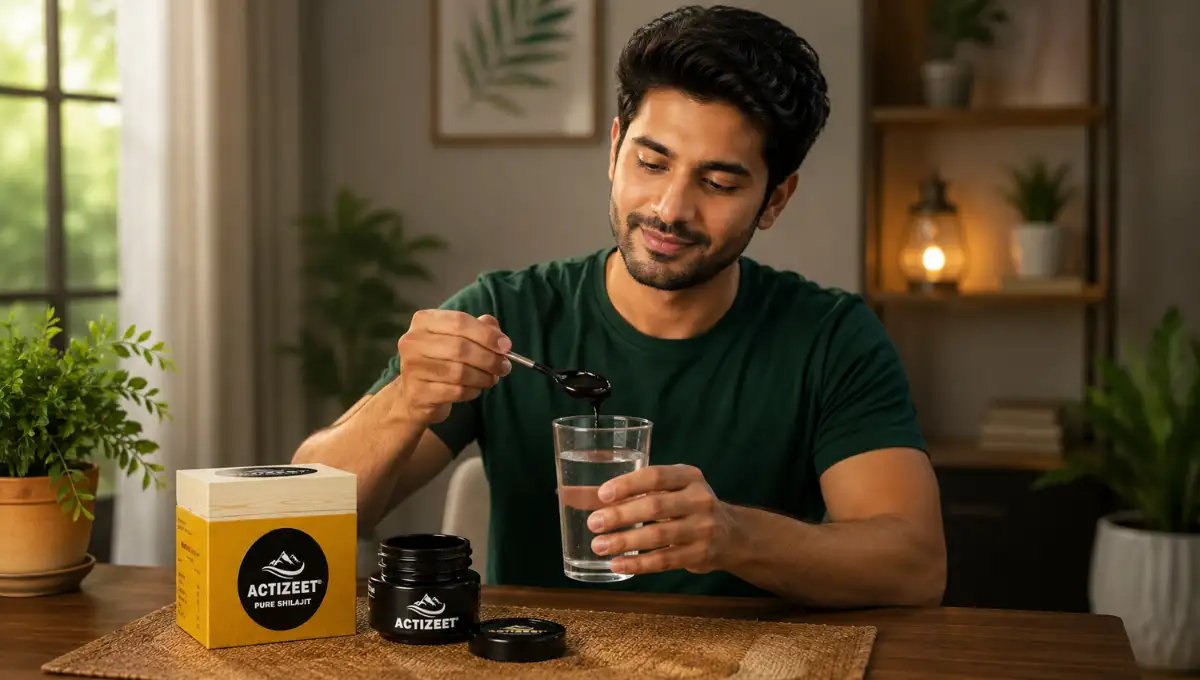
Drop the measured portion of shilajit resin directly into your warm water. Stir gently with a spoon for 30 to 60 seconds. Genuine shilajit resin will dissolve completely — turning the water a rich dark amber to deep brown color. The dissolution is complete when no visible resin particles remain and the liquid is uniformly colored. The darkness of the color (which should be consistent throughout the liquid, not patchy) is a visual confirmation of complete dissolution and is itself an authenticity indicator. Products that do not dissolve or leave significant undissolved residue should be evaluated for authenticity.
Optional Additions for Taste or Benefit
Plain shilajit water has a distinctive taste — earthy, slightly bitter, mineral-rich, with the characteristic shilajit aromatic that most users find neutral to pleasant but that surprises first-time users expecting something milder. If the taste is too strong for your palate initially, a squeeze of fresh lemon or lime (which also enhances iron absorption through vitamin C's iron-solubility mechanism), a small amount of raw honey (which adds mild taste masking alongside its own antimicrobial properties), or a pinch of cardamom can make the preparation more enjoyable without compromising the bioactive delivery. Avoid adding sugar or sweetened preparations that would add unnecessary calories and glycemic impact.
Drink on an Empty Stomach for Best Results
The most mineral-bioavailable timing for shilajit in water is 30 to 45 minutes before eating — the fasted empty stomach maximizes fulvic acid-mediated mineral absorption by eliminating the food matrix competition for intestinal mineral transporter activity. Morning is the most practical timing for most Indian users, aligning with the wake-up hydration window before breakfast. If morning timing is not feasible, the pre-dinner fasted window (2 or more hours after lunch and 30 minutes before dinner) provides the next most bioavailable absorption opportunity.
Best Water Temperature — Why This Matters More Than Most Users Realize
Water temperature is the single most important variable in shilajit water preparation, and it is the variable that most instructions and user guides underspecify. The issue is a genuine tradeoff between dissolution efficiency and compound preservation.
Cold water (below 20 degrees Celsius) dissolves shilajit slowly and incompletely at room temperature — the resin's semi-solid consistency requires warmth to become fluid enough for complete dispersion. Attempting to dissolve shilajit in cold water produces partial dissolution at best, leaving the DBP-containing resinous fraction undissolved and reducing overall compound bioavailability.
Room temperature water (25 to 30 degrees Celsius) produces better dissolution than cold water but is still suboptimal for shilajit resin — the lighter water-soluble fulvic acid fraction dissolves adequately, but the heavier resinous fraction (which contains the DBP compounds and mineral-organic complexes) requires more warmth for complete dispersion.
Warm water at 40 to 50 degrees Celsius is the sweet spot — all fractions of genuine shilajit dissolve completely at this temperature within 30 to 60 seconds of gentle stirring, the fulvic acid and ionic minerals enter solution in their most bioavailable form, and the temperature is well below the threshold at which heat-sensitive DBP compound degradation becomes meaningful (which research suggests begins above approximately 70 to 80 degrees Celsius with significant degradation occurring above 100 degrees).
Boiling water (above 90 to 100 degrees Celsius) should be avoided for shilajit preparation specifically because of DBP heat sensitivity. This is worth emphasizing because many Indian households have a cultural habit of adding supplements directly to boiling chai or boiling milk — for shilajit, wait until the liquid has cooled to the warm (not hot) temperature range before adding the resin.
Water vs Milk vs Other Liquids — The Complete Comparison
| Liquid | Fulvic Acid Absorption | Mineral Absorption | DBP Absorption | Best For | Considerations |
|---|---|---|---|---|---|
| Plain Warm Water | Excellent | Excellent — fasted | Moderate | Fasting, morning routine, simplicity, lactose intolerance | Fastest absorption; compatible with fasting; no extra calories |
| Full-Fat Warm Milk | Excellent | Excellent | Excellent — fat-soluble delivery | Maximum DBP absorption; sleep and recovery use; traditional Ayurvedic preparation | Adds calories; not suitable for lactose intolerant; breaks fasts |
| Warm Herbal Tea (unsweetened) | Excellent | Good | Moderate | Evening relaxation; combined herbal benefit; variety | Ensure herbal compounds do not interfere with mineral absorption (tannin-rich teas like black tea may reduce iron absorption) |
| Warm Water + Honey | Excellent | Excellent | Moderate | Taste improvement; mild immune synergy from honey's own antimicrobial compounds | Small glucose addition — relevant for diabetic users to monitor; breaks strict metabolic fast |
| Warm Water + Lemon | Excellent | Enhanced for iron — vitamin C increases iron absorption | Moderate | Iron-deficient women; morning detox routine; taste enhancement | Excellent combination — vitamin C enhances iron bioavailability by reducing Fe³⁺ to the more absorbable Fe²⁺ form |
| Cold Water | Reduced — poor dissolution | Reduced — incomplete dissolution | Poor | Not recommended for shilajit — incomplete dissolution reduces delivery | Resin does not fully dissolve; heavier fractions remain undispersed |
| Coffee or Strong Black Tea | Reduced — tannins interfere | Reduced — tannins chelate minerals | Moderate | Not recommended — tannins reduce mineral bioavailability | Tannins in coffee and black tea form insoluble complexes with iron and zinc, reducing the mineral benefit that is shilajit's primary water-route advantage |
When Water Is the Best Choice for Shilajit
- During intermittent fasting, OMAD, or any metabolic fast. Water is the only shilajit vehicle that does not add any metabolizable calories, does not trigger an insulin response, and does not interrupt ketosis or autophagy. For the growing number of Indian professionals practicing intermittent fasting, water preparation makes shilajit fully compatible with their fasting protocol in a way that milk preparation does not.
- Lactose intolerance — which affects an estimated 60 to 70% of India's adult population. India has among the highest rates of adult lactose intolerance globally. For the majority of Indian adults who experience digestive discomfort from cow's milk, water preparation eliminates the dairy incompatibility while maintaining full shilajit efficacy for the fulvic acid and mineral benefits that are water-delivered.
- Morning fasted absorption maximum. Empty-stomach mineral absorption through the fasted intestinal mucosa is more efficient than fed-state absorption. Water preparation on an empty stomach 30 minutes before breakfast delivers shilajit's ionic minerals in the most bioavailable timing window available during the day.
- Calorie-conscious users and weight management. Water adds zero calories to a shilajit dose. For individuals actively managing caloric intake for fat loss or body composition — a common goal among India's growing fitness community — water preparation allows consistent shilajit supplementation without any caloric impact.
- Simplicity and travel. Water is available everywhere — hotel rooms, offices, airports, trains. For consistent daily supplementation regardless of location or routine disruption, water preparation makes shilajit the most portable and most consistently available supplement preparation possible.
- Vegan and plant-based users. India's significant and growing vegan community can use shilajit with water, plant milks, or other non-dairy liquids without any animal product concerns. Water is the simplest and most universally vegan-compatible preparation vehicle.
Does Water Reduce Shilajit Absorption? An Honest Assessment
The honest answer is: water preparation delivers full absorption of the water-soluble fraction of shilajit (which includes the fulvic acid, ionic minerals, and water-soluble antioxidant compounds that constitute the majority of shilajit's bioactive profile) and partial absorption of the fat-soluble fraction (which includes the DBP compounds and some terpenoid minor compounds that benefit from lipid carriers). The relative importance of the DBP fraction versus the fulvic acid-mineral fraction depends on what specific benefits you are prioritizing.
For users primarily seeking the mineral replenishment, adaptogenic properties, and fulvic acid-related antioxidant and cellular support benefits of shilajit, water preparation delivers essentially complete bioavailability of the compounds driving these benefits. The fulvic acid is fully water-soluble and is completely absorbed through water preparation. The ionic minerals are optimally bioavailable in the fulvic acid aqueous solution through water preparation — potentially more so than in milk, where calcium from dairy can compete with absorption of other minerals at intestinal transporter sites.
For users specifically seeking the mitochondrial CoQ10-recycling energy benefits that DBP compounds provide — gym performance enhancement, sustained energy during demanding physical activity, the fatigue resistance that DBP-CoQ10 supports — milk preparation provides meaningfully better DBP compound absorption than water preparation because fat-soluble compound absorption through the lipophilic pathway is significantly enhanced by dietary lipids. For these users, morning pre-workout shilajit in water and evening recovery shilajit in milk provides a practical approach that captures both the fasted mineral absorption advantage of the morning water preparation and the maximum DBP delivery advantage of the evening milk preparation.
🏔️ ACTIZEET® Himalayan Shilajit Resin dissolves completely in warm water in under 60 seconds — the genuine water solubility of authentic high-altitude resin with fulvic acid at 60%+, confirmed by the clear, uniformly amber-brown dissolution that quality shilajit produces every time.
Get ACTIZEET® →The Water Dissolution Quality Test — How Shilajit in Water Reveals Product Authenticity
One of the most valuable aspects of taking shilajit in plain water is that the dissolution behavior in water is itself one of the most accessible authenticity tests for shilajit quality. Water is optically clear, allowing you to observe exactly how your shilajit dissolves — providing visual feedback about product authenticity that milk or other opaque preparations obscure.
What Genuine ACTIZEET® Shilajit Looks Like in Water
When you drop a pea-sized portion of genuine high-quality shilajit resin into warm water and stir, you should observe: initial softening and fragmentation of the resin into smaller pieces within 10 to 15 seconds; progressive darkening of the water to a rich amber-brown color as the water-soluble fulvic acid compounds disperse; complete dissolution of all visible resin particles within 30 to 60 seconds of gentle stirring; and a final preparation that is uniformly dark amber-brown throughout, clear when held to light (no turbidity from undissolved particles), and free of any oily film or floating residue.
What Problematic Products Show in Water
Products that are adulterated with soil, rock powder, or ozokerite wax (the most common shilajit adulterant in India's market) leave visible undissolved residue after thorough stirring — genuine shilajit's organic compounds dissolve completely, while mineral silicates from soil and rock and the mineral wax of ozokerite do not dissolve in water. Products that are highly diluted with carrier agents may show very pale amber color disproportionate to the amount used, or may create a slightly turbid preparation rather than the clear dark amber of genuine concentrated fulvic acid solution. Products that are primarily synthetic fragrance preparations (a problem with some shilajit oils and powders) may dissolve to produce an aromatic preparation but without the intense dark color of genuine concentrated fulvic acid solution. Genuine ACTIZEET® shilajit dissolves completely and clearly in warm water every time — the water dissolution test is a test this product passes definitively, and it is a test you can perform in your own home with no equipment beyond a glass of warm water.
Timing Your Water Preparation for Maximum Benefit
Morning Fasted (Best for Minerals)
30 to 45 minutes before breakfast. Empty-stomach absorption peaks. Ideal for mineral replenishment, fasting protocol compatibility, and the cognitive clarity boost of morning shilajit water preparation.
Pre-Workout (Best for Energy)
20 to 30 minutes before training. Warm water delivery gets fulvic acid and minerals into circulation during the training window. Compatible with fasted training protocols for gym-goers who train before eating.
Mid-Fasting Window
10 to 14 hours into an intermittent fast. Addresses mineral depletion building during the fast. Enhances fasted mental clarity through DBP mitochondrial support. Does not break the metabolic fast.
Evening in Water (Before Food)
30 minutes before dinner if milk is unavailable or unsuitable. Provides mineral and adaptogenic support entering the evening. Slightly less optimal than milk for DBP delivery but fully effective for mineral and fulvic acid benefits.
With Lemon (Iron Support)
Any time you want to maximize iron absorption from shilajit's ionic iron content — the vitamin C in lemon reduces Fe³⁺ to the more intestinally absorbable Fe²⁺ form, specifically benefiting iron-deficient Indian women using shilajit for iron replenishment.
Travel and Routine Disruption
Whenever milk is unavailable. A glass of warm water from a hotel kettle or office microwave is always accessible. Water preparation makes daily supplementation consistent regardless of location or schedule disruption.
Why ACTIZEET® Dissolves Perfectly in Water — Quality You Can See
Not all shilajit products dissolve in water the same way, and the differences in dissolution behavior reflect genuine differences in product quality and authenticity. ACTIZEET® Himalayan Shilajit Resin's complete, rapid, and uniformly amber dissolution in warm water is a direct consequence of the quality factors that make it the best shilajit in India.
- Fulvic acid at 60%+ — the water-soluble compound whose high concentration produces the rapid, complete, deeply colored dissolution that confirms genuine quality. Lower fulvic acid content from adulterated or poor-quality shilajit produces paler, less complete dissolution behavior. The intensity of ACTIZEET®'s amber-brown dissolution color is a direct quality indicator.
- Cold-processed resin preservation maintaining the fulvic acid molecular structure in its most water-solubility-optimized form. Heat processing that converts shilajit to powder creates chemical changes in the fulvic acid polymer structure that reduce water solubility and dissolution rate — another reason ACTIZEET®'s resin form dissolves more completely and more consistently than powder preparations.
- No ozokerite wax or rock powder adulteration — genuine organic resin dissolves completely, leaving no residue that would indicate inorganic adulterants. The residue-free dissolution that ACTIZEET® consistently delivers in water is both a quality indicator and a safety confirmation — what you see dissolving is genuine bioactive shilajit, nothing left behind.
- Single ingredient — no fillers, binders, or carrier additions that would change the dissolution behavior from genuine shilajit's characteristic pattern.
Drop a pea-sized amount of ACTIZEET® Himalayan Shilajit Resin into warm water, stir for 30 to 60 seconds, and watch it dissolve completely into a rich, uniformly dark amber preparation whose color tells the story of 60%+ fulvic acid concentration from genuine high-altitude Himalayan geological formation. No residue. No turbidity. No incomplete dissolution. Just the most bioavailable water-soluble mineral and fulvic acid preparation available from any natural supplement source — in the simplest, most portable, most flexible preparation that anyone can make anywhere in India with nothing more than warm water and a spoon.
🏔️ Order ACTIZEET® Himalayan Shilajit Resin →What to Avoid When Taking Shilajit with Water
- Boiling water directly from the kettle. Let boiling water cool for 5 to 7 minutes before adding shilajit. Temperatures above approximately 70 to 80 degrees Celsius begin degrading the heat-sensitive DBP compounds that provide mitochondrial and adaptogenic benefits. Warm, not hot, is the consistent message.
- Chlorinated tap water without filtering first. India's municipal tap water in most cities contains chlorine that, while fine for drinking purposes, can potentially interact with the organic compounds in shilajit solution. Filtered, purified, or mineral water is preferable for shilajit preparation where possible.
- Strong black tea or coffee as the mixing liquid. Tannins in both form insoluble complexes with iron, zinc, and other ionic minerals in shilajit, reducing the mineral bioavailability that is the primary advantage of water-route shilajit delivery. Use plain water or herbal tea for shilajit rather than tannin-rich beverages.
- Carbonated or fizzy water. Carbonated water's CO2 creates a slightly acidic pH that may affect some of the ionic mineral species in shilajit solution. While not a serious concern, still water is preferable to sparkling water for shilajit preparation.
- Shared utensils introducing moisture into the shilajit jar. Always use a clean, dry spoon or tool to take shilajit from the container. Wet utensils introduced into the jar can cause moisture accumulation that may accelerate oxidation of the remaining resin over time, reducing its shelf-quality.
Frequently Asked Questions
Can Shilajit Be Taken with Water? Absolutely — And Here Is Why It Might Be Your Best Option
Water is not a compromise preparation vehicle for shilajit — it is a genuinely excellent one, and for a large proportion of Indian shilajit users, it is actually the best option for their specific context. Whether you are practicing intermittent fasting, managing lactose intolerance, optimizing fasted morning mineral absorption, working out before breakfast, traveling with limited beverage options, or simply preferring the no-calories simplicity of warm water preparation, taking shilajit with water delivers the full fulvic acid and ionic mineral benefits of genuine Himalayan shilajit through the most natural aqueous medium that these water-soluble compounds evolved to operate in.
The quality test that water provides — the clear, uniformly dark amber dissolution of genuine high-quality resin — is itself a reason to take shilajit in water at least occasionally. It confirms that what you have is the real thing. And with ACTIZEET® Himalayan Shilajit Resin, it will pass that test every single time: complete dissolution, rich amber color, no residue, and the genuine bioactive profile of authentic high-altitude Himalayan shilajit in the simplest preparation available from any natural supplement in India.
Latest From Our Blog

How to Restore Energy and Stamina by using Shilajit
Discover the ancient secret to restoring energy and stamina naturally....

What is Humic Acid in Shilajit? Unveiling the Forgotten Force That Works Silently Inside You
What is Humic Acid in Shilajit? Discover how this powerful...

Shilajit for Athletic Performance: Unlock Natural Strength, Endurance, and Recovery
Discover how Shilajit supports athletic performance, energy, endurance, stamina, testosterone,...

Can Shilajit Help with Premature Ejaculation? A Mechanism-Based Answer for Indian Men Seeking Real Solutions
Can shilajit help with premature ejaculation? Discover the testosterone, serotonin,...